
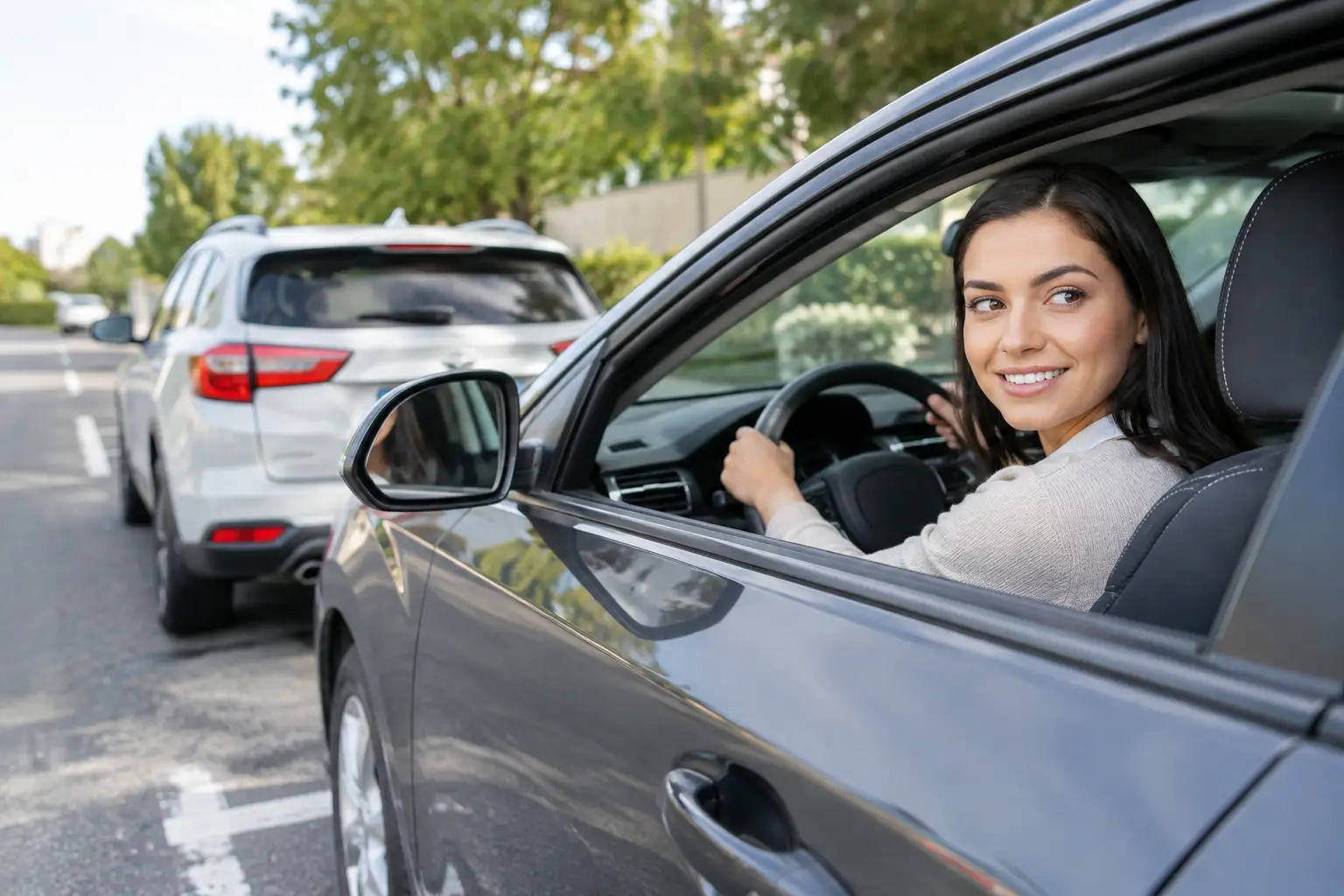
A quiet residential street, an open space between two parked cars, and an instructor calmly saying, “Take your time,” can change how parallel parking practice feels. What often looks like one stressful DMV test maneuver is really a series of small, learnable decisions: checking for traffic, controlling speed, judging space, steering accurately, and finishing safely near the curb.
For new drivers, the goal is not to park perfectly on the first try. The goal is to develop a method that works in different neighborhoods, vehicles, and parking spaces. With patient repetition, parallel parking becomes less about memorizing a magic trick and more about understanding what the car is doing.
Why Parallel Parking Feels So Difficult
Parallel parking asks a new driver to manage several skills at once. You are looking in mirrors, checking blind spots, signaling, reversing slowly, turning the wheel, and watching the distance to the curb and surrounding vehicles. If you are worried about holding up traffic or bumping another car, that can make every movement feel rushed.
The South Bay also presents real-world variation. A wide, quiet Torrance street may offer more room than a tighter space near a busy shopping area or a hillside neighborhood. Different curbs, street widths, parked vehicle sizes, and slopes all affect the maneuver. That is why a fixed set of reference points can be helpful at first, but should never replace careful observation.
A good lesson breaks the task into manageable stages. Instead of trying to remember every action at once, a student learns where to look, when to pause, and how to make a calm correction.
Set Up for Safer Parallel Parking Practice
Start in a low-pressure environment. An empty curb with cones or clear markers is useful for learning the steering pattern before practicing between real cars. Once the motions are familiar, move to wider legal parking spaces on quiet streets. Practice should always be supervised by a qualified adult or instructor when required by the driver’s permit conditions.
Before attempting the maneuver, make sure you can comfortably reach the brake and pedals, see clearly through the rear window, and use your mirrors effectively. Your seat position matters more than many learners realize. If you are sitting too far back or too low, curb distance and surrounding traffic are harder to judge.
Use this brief routine before every attempt:
- Check that the space is large enough for your vehicle.
- Signal early so other road users understand your intention.
- Check mirrors and look over your shoulder for cyclists, pedestrians, and traffic.
- Move slowly enough that you can stop and reassess at any point.
The word “slowly” is key. Parallel parking should be controlled by the brake, not hurried by the gas pedal. In most situations, a gentle creep gives you time to see how the vehicle is responding.
A Repeatable Parallel Parking Method
Exact reference points differ by vehicle, so use the following as a framework rather than a rigid formula. A taller SUV, compact sedan, or vehicle with a backup camera will give you different visual cues. The safety checks and controlled movements, however, remain the same.
1. Pull Beside the Vehicle Ahead
Signal and pull alongside the car in front of the open space. Leave enough side distance to avoid crowding it, generally about two to three feet when conditions allow. Stop with your vehicle roughly even with the other vehicle, then check mirrors and your blind spot again before reversing.
Do not depend solely on a backup camera. Cameras can help show the curb area, but they do not replace looking behind you and monitoring the full traffic environment. California drivers must remain responsible for what is around the vehicle.
2. Reverse at a Crawl and Turn Into the Space
Release the brake gradually and begin reversing very slowly. As the rear of your vehicle enters the space, turn the steering wheel toward the curb. Look primarily through the rear window while using quick mirror checks to monitor the vehicle beside you and the curb.
The purpose of this first turn is to bring the rear of the vehicle into the parking space. Many beginners turn too quickly because they are afraid of missing the opening. A slower approach makes it easier to pause before getting too close to the curb or another vehicle.
3. Straighten, Then Turn Away From the Curb
When your vehicle is at the appropriate angle and the front has cleared the vehicle ahead, straighten the wheel briefly. Then turn away from the curb to bring the front of the vehicle into the space. This is the part that feels least intuitive until students see it happen several times.
Stay alert for the front corner of your car. A common mistake is focusing so closely on the curb that the front swings too near the vehicle ahead. Controlled speed and frequent visual checks give you time to prevent this.
4. Center the Vehicle and Finish Securely
Once the car is parallel with the curb, straighten the wheels and make small adjustments if needed. You should be reasonably close to the curb without touching it, with enough room in front of and behind the vehicle for other drivers to park or leave safely.
After stopping, shift into park and set the parking brake when appropriate. On a hill, follow California safe-parking practices for wheel direction and securing the vehicle. Before opening the door, check for approaching cyclists, vehicles, and pedestrians.
How to Correct Without Panicking
A correction is not a failure. Experienced drivers regularly make small adjustments when parking, especially in unfamiliar spaces. During DMV road-test preparation, students should learn to correct safely rather than forcing an imperfect first attempt.
If you are too far from the curb, stop, assess your position, and make a controlled adjustment. If you are too close to the car ahead or behind, do not continue hoping it will work out. Stop before contact, pull forward or reverse as needed, and reset your angle. The safest decision is often to start again.
What should not happen is a rushed correction without looking. Every change in direction requires attention to traffic, pedestrians, and the area around the vehicle. A driver who pauses, checks, and adjusts is demonstrating sound judgment.
Common Habits That Make Parking Harder
Students often struggle because they look only at one point. Watching the curb alone can lead to a swing into the vehicle ahead. Looking only through the rear window can make it easy to lose track of side clearance. Train your eyes to move deliberately among the rear window, mirrors, curb, and surrounding traffic.
Another issue is turning the wheel while the car is stopped for too long. Steering is generally easier on the vehicle when it is moving slowly, and the movement also helps students understand how the car responds. Still, a brief stop to check for safety is always better than moving when unsure.
Finally, do not practice only in one familiar location. Once you understand the steps, try spaces with different lengths and road widths. The goal is adaptable judgment, not a routine that works only on one block.
Practice for the DMV Test and Everyday Driving
California DMV road-test routes and examiner instructions can vary, so no driver should assume that a single memorized parking sequence guarantees success. The stronger preparation is being able to demonstrate safe observation, smooth vehicle control, proper signaling, and a willingness to correct when necessary.
For teens, adults learning later in life, and returning drivers, professional behind-the-wheel instruction can make this practice less intimidating. A patient instructor can identify whether the challenge is steering timing, mirror use, speed control, or anxiety, then tailor practice accordingly. At South Bay Driving School, parking instruction is approached as part of becoming a safe, capable driver, not as a trick to get through one test.
Give yourself permission to take the space slowly. Each calm attempt teaches you more than a rushed “perfect” park ever will.