
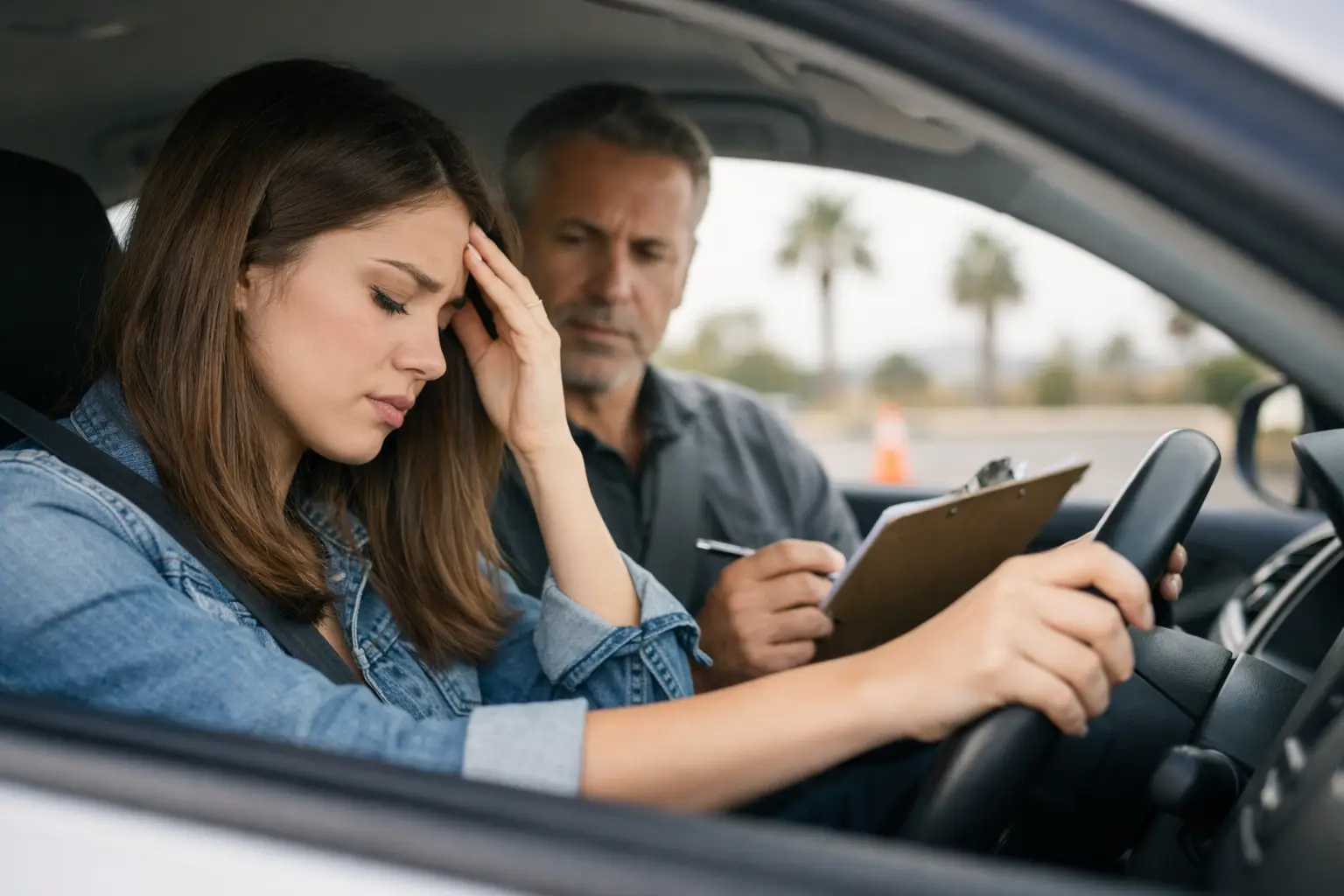
A road test can feel like one high-pressure drive, but what causes road test failure is usually not one mysterious mistake. Most unsuccessful tests come from a pattern the examiner can see: incomplete observation, rushed decisions, weak vehicle control, or actions that create risk for other people on the road.
For new drivers and returning drivers alike, the encouraging part is that these are teachable skills. The goal is not to drive perfectly or impress the examiner. It is to show that you can make safe, legal, repeatable decisions in normal traffic.
What Causes Road Test Failure Most Often?
California DMV examiners evaluate whether a driver can control the vehicle, follow traffic laws, observe their surroundings, and respond safely to real conditions. A small correction, a brief moment of hesitation, or an imperfect park does not automatically mean failure. What matters is whether an error affects safety, breaks a traffic law, or shows that the driver needs more practice before driving independently.
The most common problems tend to appear during the same everyday tasks: pulling away from the curb, approaching intersections, turning, changing lanes, backing up, and reacting to traffic around the vehicle. Nerves can make these skills harder because they cause drivers to look only straight ahead, rush a decision, or forget a routine they normally know.
Incomplete Observation at Intersections
Many road-test errors begin before the car even moves through an intersection. Drivers may stop fully but fail to scan left, right, and ahead before proceeding. Others focus on a green light and miss a pedestrian entering a crosswalk, a cyclist near the curb, or an oncoming vehicle that makes a turn unsafe.
At a stop sign, come to a complete stop behind the limit line, crosswalk, or corner. Then take the time to check for cross traffic and pedestrians. A rolling stop is a traffic violation, and proceeding without a clear view can create a serious safety concern.
Observation also matters at uncontrolled intersections, railroad crossings, driveways, and when leaving the curb. Examiners need to see that your eyes are actively checking the areas where a conflict could occur.
Unsafe Turns and Poor Lane Position
Turns combine several driving skills at once: speed control, signaling, scanning, yielding, steering, and proper lane placement. That is why they are a frequent source of road test failure.
A right turn should generally begin and end in the lane nearest the right curb, unless road markings or signs direct otherwise. Drivers sometimes swing too wide into another lane, turn from the wrong position, or cut the corner too sharply. Before turning right, check mirrors and the area beside the vehicle for bicycles, pedestrians, and other road users.
Left turns require patience. Yield to oncoming traffic and pedestrians unless you have a protected arrow. Do not turn simply because the vehicle behind you is waiting. A safe driver waits for a legal gap, even if that means remaining at the intersection through another light cycle.
Speed matters during every turn. Entering too quickly can lead to drifting, wide turns, or a loss of control. Slowing smoothly before the turn gives you more time to look, steer accurately, and finish in the correct lane.
Lane Changes Without a Full Safety Check
A mirror check alone is not enough for a lane change. Mirrors help you see traffic behind you, but they do not show every vehicle beside your car. Before moving over, signal early, check mirrors, look over your shoulder for the blind spot, and move only when there is enough space.
Common problems include changing lanes too quickly, moving into a gap that is too small, drifting across a lane line without signaling, or forgetting to cancel the signal after the maneuver. On busy South Bay streets and multi-lane roads, drivers also need to keep their speed steady rather than slowing abruptly while they decide whether to change lanes.
If a lane change is not necessary, do not force one just because you think the examiner expects it. Follow the route safely and make the maneuver only when instructed or when traffic conditions clearly allow it.
Speed That Does Not Match Conditions
Driving over the speed limit is an obvious concern, but driving too slowly can also create problems when it unnecessarily disrupts traffic. The appropriate speed depends on the posted limit, traffic flow, road width, visibility, pedestrians, parked cars, and weather.
A driver who travels far below the limit on a clear road may cause other drivers to brake or pass unexpectedly. On the other hand, driving at the posted limit may be too fast near a school, a crowded crosswalk, a narrow residential street, or a line of parked vehicles where a door could open.
Practice reading speed limit signs early and adjusting gradually. Avoid staring at the speedometer for long periods. A quick glance is enough when combined with awareness of how the vehicle feels and how traffic is moving.
Serious Safety Errors Can End the Test
Some mistakes carry more weight because they create an immediate hazard. The exact outcome depends on the situation and the examiner's judgment, but unsafe actions can result in an unsuccessful test before the route is complete.
Examples may include requiring the examiner to intervene, nearly colliding with another vehicle or pedestrian, entering traffic when it is unsafe, ignoring a stop sign or red light, or striking a curb during a maneuver. Failing to yield can be especially serious because it places the right-of-way burden on someone else.
Do not let fear of a serious error make you overly cautious. Safe driving is not frozen driving. When it is your turn to go and the path is clear, proceed with purpose. Excessive hesitation at a safe opportunity can confuse traffic and suggest that you are not yet comfortable making decisions.
Vehicle Control Problems That Need Practice
A road test measures how well you manage the vehicle, not just whether you remember the rules. Rough braking, sudden acceleration, inconsistent steering, or repeated lane drifting can indicate that basic control needs more practice.
Keep both hands positioned for controlled steering, except when briefly operating necessary controls. Look well ahead instead of directly over the hood. Looking farther down the road helps the vehicle travel straighter and gives you time to react without abrupt movements.
During backing, move slowly and continue checking the area behind the car. Use your mirrors, but turn and look through the rear window when backing whenever appropriate. Do not rely only on a backup camera. Cameras are helpful tools, but they do not replace direct observation.
Curbside parking and backing in a straight line can make drivers nervous because the examiner is watching closely. The answer is not to rush. Set up correctly, use slow and steady steering, check for traffic, and make small corrections. One calm correction is safer than a large, hurried one.
Starting the Test Before You Are Ready
Some failures happen before the driving portion begins. The vehicle must be safe and legal for the test. If required equipment is not working, the vehicle may not be accepted. Check lights, turn signals, brake lights, tires, windshield condition, mirrors, doors, seat belts, and current registration and insurance well before the appointment.
The applicant also needs the required documents and a properly licensed driver to bring the vehicle when required. Confirm current DMV requirements before test day, since procedures can change. Arriving early gives you time to adjust your seat, mirrors, steering wheel, and climate controls without feeling rushed.
A quick warm-up drive can be useful, but avoid exhausting yourself with hours of last-minute practice. Use that time to settle into the vehicle and review the habits that matter most: complete stops, active scanning, smooth speed control, proper signaling, and patient decision-making.
How to Practice for a Safer, Calmer Test
Practice should resemble the kind of driving you will be asked to do, not just empty-parking-lot driving. Include residential streets, busier intersections, lane changes, turns near pedestrians, stop signs, parking, and backing. Repeating the same familiar route can build comfort, but it may not reveal weak habits until you practice in different traffic conditions.
Ask your practice partner or instructor to watch for one skill at a time. For example, spend one drive focusing on complete stops and intersection scanning. On the next drive, focus on lane changes and blind-spot checks. Breaking practice into specific skills makes feedback easier to use and prevents every drive from becoming a stressful scorecard.
For nervous teens, adults, and seniors, professional instruction can also help separate anxiety from an actual skill gap. A patient instructor can identify whether hesitation comes from uncertainty about right-of-way, weak mirror habits, unfamiliarity with the vehicle, or simply a need for more repetition. South Bay Driving School prepares students on the local roads they may encounter around Torrance and neighboring communities, with instruction paced to the individual driver.
The best way to approach the DMV road test is to treat it as a safety demonstration, not a performance. Give yourself enough time to look, make legal choices, and control the car smoothly. The habits that help you pass are the same habits that protect you long after the temporary license has been replaced by years of everyday driving.