
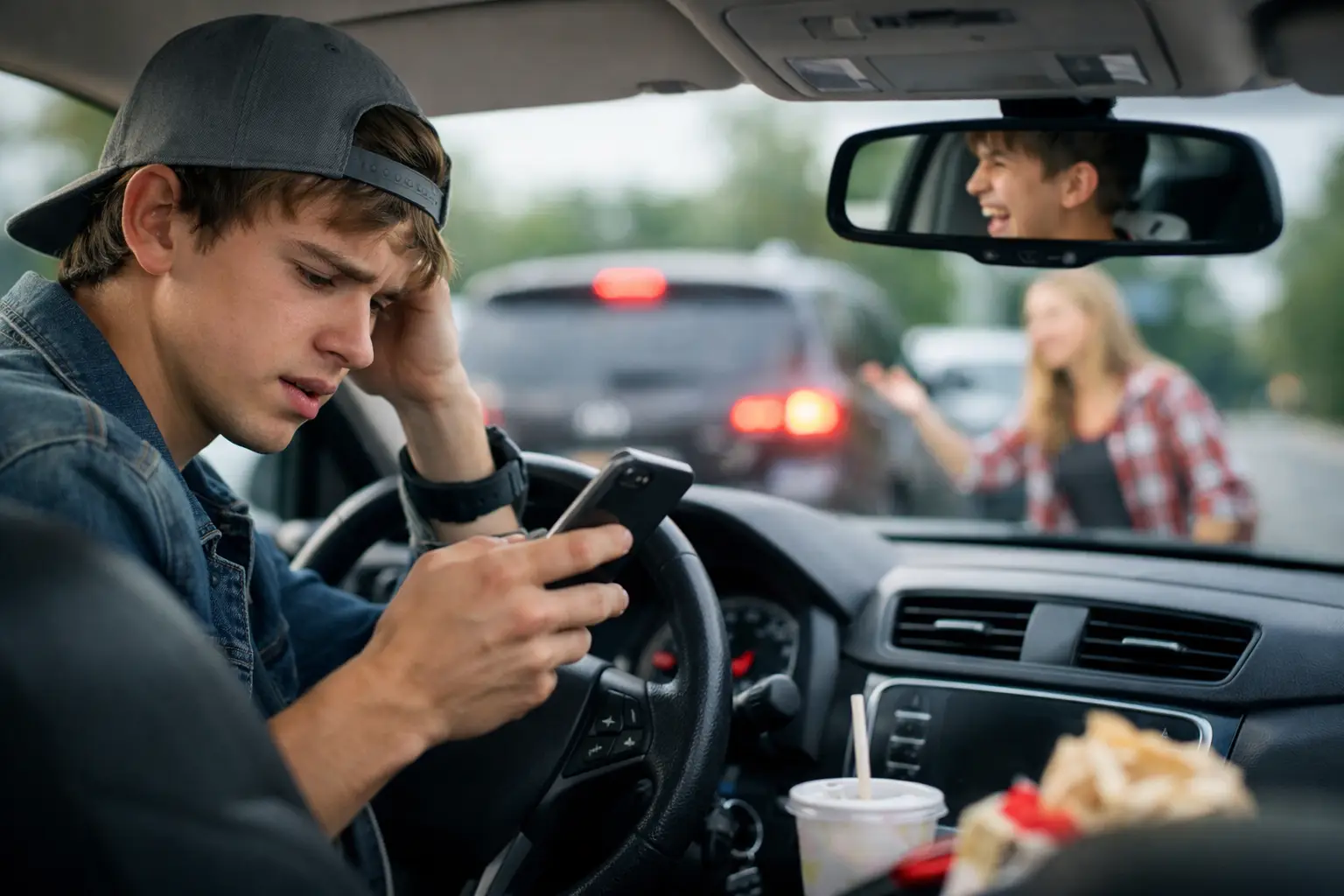
A driver can know the rules well enough to pass a written test and still make risky choices in the first few seconds behind the wheel. The top teen driving mistakes usually are not dramatic. They are small, repeatable habits: rolling through a stop, looking too long at a phone, following too closely, or turning without a final check for pedestrians.
For teens learning to drive in Torrance and throughout the South Bay, the goal is more than checking off DMV requirements. It is learning how to make calm, safe decisions around busy intersections, freeway traffic, cyclists, pedestrians, and changing road conditions. Here are the mistakes professional instruction helps new drivers recognize and correct early.
1. Looking at a Phone "Just for a Second"
A quick glance at a message, map, playlist, or notification takes a driver's eyes off the road longer than most people realize. At city speeds, a vehicle can travel the length of several cars while the driver is looking down. For a new driver who is still building steering, braking, and traffic-scanning skills, that gap is especially dangerous.
Put the phone away before shifting into drive. Set navigation, music, and any needed settings while parked, then leave the device out of reach. If directions change or an urgent call comes in, pull over safely before responding. Passengers can help with navigation, but they should not become another distraction.
2. Making Rolling Stops
California requires a complete stop at stop signs and red lights before the limit line, crosswalk, or intersection. Many teens slow down substantially but allow the vehicle to keep creeping forward. That can lead to a DMV road-test error, but the more serious concern is what may be entering the crosswalk or crossing street.
Practice a deliberate stop: brake smoothly, bring the car fully to rest, scan left, right, and left again, then proceed only when the path is clear. At intersections near schools, shopping areas, and residential streets, take extra time to look for pedestrians, scooters, and vehicles that may not yield as expected.
3. Following Too Closely
New drivers often focus on the car directly ahead instead of the space around their vehicle. When traffic slows suddenly, a short following distance leaves little time to recognize the problem, move a foot to the brake, and stop smoothly.
Use at least a three-second following distance in normal, dry conditions. Choose a fixed object ahead, such as a sign or light pole, and count after the vehicle in front passes it. Increase that space at night, in rain, in heavy traffic, or when following motorcycles and large trucks. More room gives a teen driver more choices, which is one of the most useful forms of protection on the road.
4. Driving Too Fast for Conditions
Speed limits matter, but a posted limit is not always the safest speed. Traffic congestion, wet pavement, glare from the sun, curves, construction, and limited visibility can all require a driver to slow down. A teen may also drive too quickly when feeling pressure from drivers behind them.
The right response to a tailgater is not to speed up beyond a comfortable, safe pace. Maintain a reasonable speed, create space ahead, and change lanes or pull over when it is safe and practical. Good driving is not about keeping every impatient driver happy. It is about staying in control of the vehicle.
5. Missing Blind-Spot Checks
Mirrors show much of the traffic around a vehicle, but they do not show everything. Before changing lanes, merging, pulling away from a curb, or moving around a cyclist, drivers need a brief shoulder check to confirm the blind spot is clear.
A proper lane change is a sequence, not a quick steering movement: check mirrors, signal early, check the blind spot, and move gradually when there is enough room. Teens should avoid drifting across lanes or changing lanes at the last moment to catch an exit. Missing a turn is inconvenient. A rushed lane change can cause a collision.
6. Treating Yellow Lights as a Signal to Accelerate
A yellow light warns that the signal is changing. It does not mean a driver should automatically speed up to get through the intersection. Trying to beat a red light is particularly risky when visibility is limited or when opposing traffic may begin turning.
When a light turns yellow, assess whether you can stop safely before the limit line. If you can, brake smoothly and stop. If you are too close to stop safely, continue through cautiously without accelerating. Building this judgment takes practice, which is why supervised driving on real local roads matters.
7. Turning Without Checking for Pedestrians and Cyclists
A driver can have a green light and still need to yield. People in crosswalks, cyclists traveling alongside traffic, and pedestrians entering late may be difficult to see when a driver is concentrating only on other cars. Right turns are a frequent trouble spot, especially when the driver is watching for a gap in vehicle traffic but not scanning the crosswalk.
Before every turn, slow down and check the crosswalk and the area beside the vehicle. Keep the wheels straight while waiting to make a left turn, rather than turning them toward oncoming traffic. If another vehicle hits the car from behind, straight wheels reduce the chance of being pushed into opposing lanes.
8. Braking Late or Abruptly
Hard braking often starts with looking too close to the front of the car. When drivers scan farther ahead, they see slowing traffic, red lights, and changing conditions earlier. That gives them time to ease off the accelerator and brake gradually.
Smooth stops are not just a comfort skill. They help prevent rear-end crashes, give drivers behind you clearer warning, and demonstrate vehicle control during a DMV drive test. In a safe practice setting, teens can learn the feel of steady brake pressure instead of waiting until the last moment.
9. Letting Passengers Set the Tone
Friends can make driving feel more fun, but extra conversation, loud music, laughter, and peer pressure can pull attention away from the road. California's provisional license rules also limit teen passengers during the first 12 months, with specific exceptions. Families should review current DMV rules together before a newly licensed teen begins driving independently.
A helpful family standard is simple: the driver controls the car and the atmosphere in it. That means music stays at a manageable volume, passengers respect quiet moments in heavy traffic, and no one pressures the driver to speed, race a light, or make an unsafe turn.
10. Practicing Only on Easy, Familiar Streets
Confidence grows when practice is paced, but practice that never progresses can leave a teen unprepared. A driver who is comfortable only on quiet neighborhood streets may struggle with multilane roads, freeway entrances, busy parking lots, dusk driving, or unfamiliar intersections.
The answer is not to put a beginner into the hardest situation immediately. Add one new challenge at a time. After a teen can consistently manage basic turns, stops, lane position, and parking, practice routes can gradually include busier streets, lane changes, commercial areas, and DMV-style maneuvers. A patient instructor can identify what needs more repetition without overwhelming the student.
How Parents Can Help Build Safer Habits
Parents and guardians play a major role between formal lessons. Before each drive, agree on one or two skills to focus on, such as maintaining following distance or checking crosswalks before turns. Afterward, ask the teen what felt difficult before offering feedback. That approach encourages honest reflection instead of making every practice drive feel like a test.
It also helps to model the behaviors you expect. Put phones away, use signals consistently, leave room behind other cars, and avoid criticizing other drivers in a way that promotes impatience. Teen drivers learn from instruction, but they also learn from the everyday driving they see.
Safe driving develops through repetition, feedback, and gradually broader experience. South Bay Driving School helps teens build those habits at a pace that supports confidence while keeping safety first. The best time to correct a small driving mistake is before it becomes an automatic habit.