
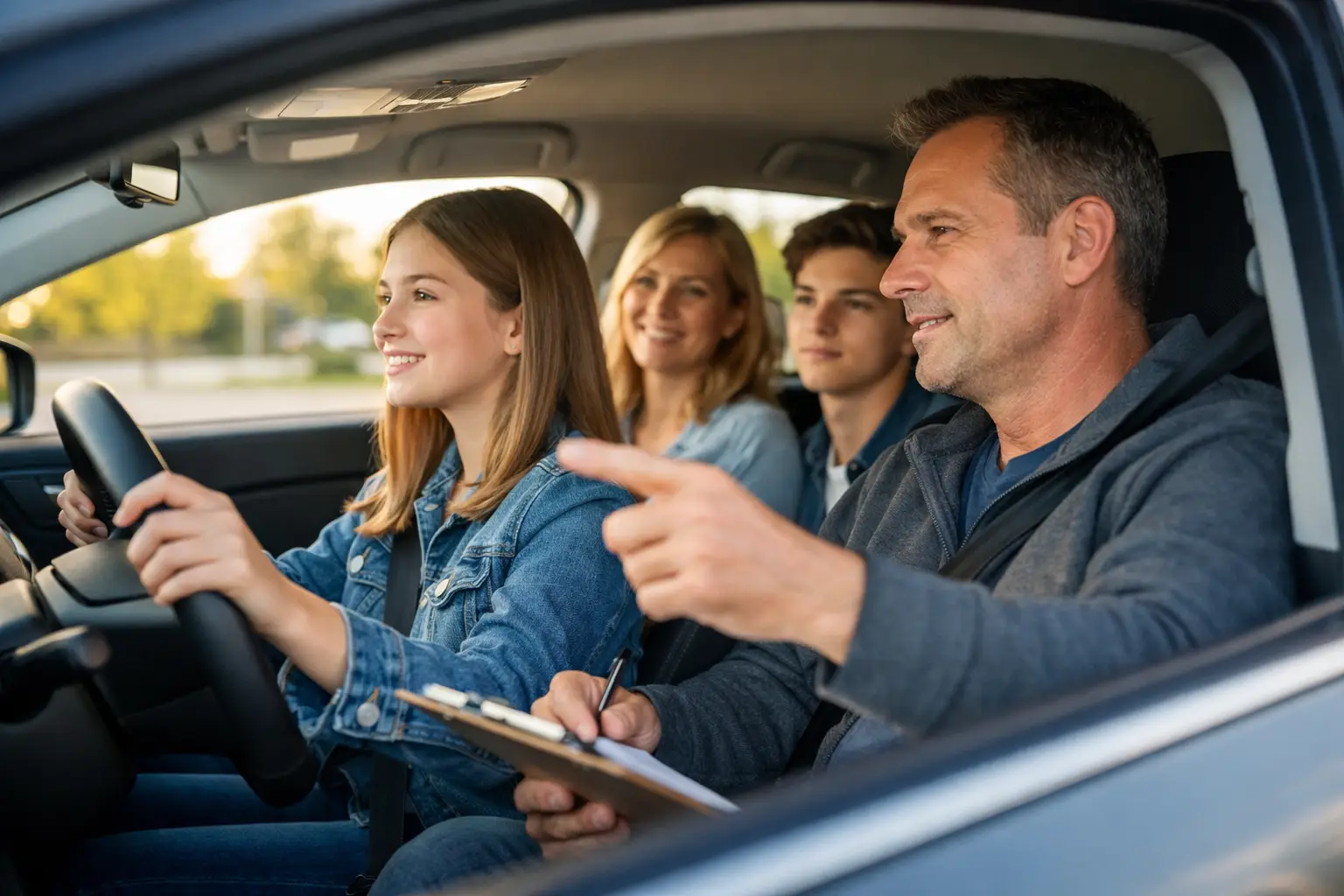
The first few permit drives can feel surprisingly quiet. Your teen is concentrating hard, you are watching every parked car and stop sign, and neither of you may be sure when to speak up. A good teen supervised driving practice guide gives families a structure for those hours so practice builds judgment and confidence instead of anxiety.
For California teens, supervised practice is not simply a box to check before the DMV road test. It is where new drivers learn how a vehicle feels in traffic, how far away hazards can be, and how to make safe decisions when the road does not go as planned. The goal is not to make every drive perfect. The goal is to make safe habits repeatable.
Start With California Permit Requirements
Before planning practice drives, confirm that your teen has a valid California instruction permit and that the supervising driver meets California's requirements. The supervising driver should be at least 25 years old and hold a valid California driver license. California generally requires teens to complete at least 50 hours of supervised driving practice, including 10 hours at night, before applying for a provisional license. A parent or guardian certifies those hours when the teen is ready for the driving test.
Teens must also meet California's other licensing milestones, including holding the permit for the required period and completing professional behind-the-wheel instruction. Requirements can change, so families should verify current details with the California DMV before scheduling a test.
A log is useful even if your teen seems to be progressing quickly. Record the date, time, duration, weather, route type, and skills practiced. A simple record helps ensure night hours are not left until the final weeks, and it shows where more practice is needed. It also gives parents a clearer picture of progress than relying on one particularly good or difficult drive.
Set Up the Car Before the Car Moves
Many preventable mistakes begin before the vehicle leaves the curb. Take two minutes at the start of every drive to establish the same routine: adjust the seat, mirrors, steering wheel position, and climate controls; buckle seat belts; silence or put away phones; and identify the route.
Your teen should be able to reach the brake pedal firmly and see clearly through the mirrors without leaning. Encourage them to set the mirrors themselves, then check the view together. This small routine teaches ownership. A teen who depends on someone else to prepare the car may also depend on someone else to notice a problem.
For the first sessions, choose a vehicle that is familiar, mechanically sound, insured for the teen's use, and free of unnecessary distractions. Avoid practicing when either person is rushed, frustrated, overly tired, or dealing with a packed schedule. Fifteen focused minutes in a quiet neighborhood can teach more than an hour spent tense in heavy traffic.
Build Skills in a Safer Order
The most effective supervised practice moves from low-pressure environments to more complex ones. Do not treat every drive as a test. Let your teen repeat a skill until it becomes comfortable, then add one new demand at a time.
Begin With Vehicle Control
Start in an empty parking lot or a very quiet residential area. Practice smooth starts and stops, steering through wide turns, backing in a straight line, parking near a curb, and scanning before moving. At this stage, the important lesson is not speed. It is looking ahead, using mirrors, and controlling the vehicle smoothly.
New drivers often focus directly in front of the hood. Remind your teen to look well down the road, then bring their eyes back to mirrors, intersections, pedestrians, and the space around the car. Good vision habits make braking and turning less abrupt.
Add Neighborhood and City Driving
Once basic control is steady, practice on residential streets with stop signs, parked vehicles, cyclists, and pedestrians. This is where teens learn that an intersection is not clear simply because they have the right-of-way. They need to search left, right, and left again, watch for turning cars, and expect someone else to make an error.
Then add busier streets during daylight. Work on lane position, safe following distance, lane changes, controlled left and right turns, and responding to traffic lights. In South Bay communities, this may include practicing around busy commercial areas, school zones, wide boulevards, and streets where pedestrians and cyclists are common. Choose the time of day carefully. A familiar route at a quieter hour is a better first step than rush-hour traffic.
Practice Higher-Speed Roads and Freeways Last
Freeway driving asks a teen to manage speed, spacing, mirrors, blind spots, and merging decisions at once. Wait until they can maintain lane position, check mirrors consistently, and make calm lane changes on surface streets.
For a first freeway session, pick a short route outside peak traffic times. Discuss the merge before entering: accelerate with traffic flow, check mirrors and blind spot, choose a safe gap, and avoid stopping at the end of the ramp unless traffic requires it. Practice exits separately, too. Last-second lane changes are a common source of stress and risk. Missing an exit is inconvenient; forcing the move is unsafe.
Coach Clearly Without Taking Over
The supervising adult sets the emotional temperature in the car. Sharp corrections, constant commentary, or a raised voice can make a teen freeze or focus on pleasing the adult instead of reading the road. That does not mean staying silent about danger. It means giving useful direction early enough for the teen to act safely.
Try to use short, specific coaching. Say, "Check the crosswalk before the turn," rather than, "Be careful." Say, "Start braking gently now," rather than waiting until the car is too close and reacting loudly. Before a known challenge, explain what the teen will need to watch for. Afterward, discuss one thing that went well and one skill to repeat next time.
If an immediate hazard develops, be direct. Safety comes before a teaching moment. Ask the teen to pull over when it is safe if either of you needs a reset. A paused drive is not a failed drive. It is a responsible choice.
Parents should also resist giving conflicting instructions. If multiple adults supervise practice, agree on basic language and standards for following distance, turns, lane changes, and speed. Teens improve faster when expectations are consistent.
Make Night, Weather, and Parking Part of the Plan
Night driving should not be saved for the end of the permit period. It changes visibility, depth perception, glare, and the amount of time available to react. Begin at dusk on familiar streets, then gradually practice fully dark conditions, headlights, reflective signs, and reduced visibility around pedestrians.
Weather practice is valuable, but it depends on conditions and the teen's readiness. Light rain can teach slower speeds, longer following distances, and gentle braking. Heavy rain, standing water, dense fog, or high winds are not beginner practice opportunities. If conditions feel beyond the driver's current skill level, postpone the drive.
Parking deserves regular attention because it often receives less practice than driving forward. Work on curb parking, backing, pulling into a space, and leaving a space while checking for approaching cars, pedestrians, and cyclists. California DMV test preparation should include the specific maneuvers your teen may be asked to perform, but real parking skill matters long after test day.
Use Professional Lessons Alongside Family Practice
Family practice and professional instruction serve different purposes. A parent knows the teen's habits, schedule, and comfort level. A qualified instructor brings a neutral perspective, a structured lesson plan, and experience identifying errors that families may not notice.
This combination can be especially helpful when a teen is nervous, a parent and teen are struggling to communicate in the car, or practice has reached a plateau. Professional lessons can also prepare students for the DMV road test while helping them build practical skills for everyday South Bay driving, from busy intersections to freeway ramps.
At South Bay Driving School, instruction is designed to complement supervised home practice with patient, individualized coaching. Families can use each professional lesson as a guide for the next several practice drives rather than treating it as a separate task.
Know When Your Teen Is Ready for the DMV Test
Logged hours alone do not always mean a teen is road-ready. Look for consistency. Your teen should be able to manage routine drives without repeated reminders to scan intersections, check mirrors, maintain speed, or leave enough following distance. They should recover calmly from a missed turn, an unexpected pedestrian, or another driver's mistake.
A practice road test can reveal gaps, but avoid making every session feel like an exam. The better question is whether your teen makes safe choices when something is unfamiliar. DMV testing evaluates specific skills, yet the habits that protect a new driver begin with everyday decisions.
On the next drive, choose one skill your teen can own from start to finish - perhaps a smooth lane change, a quiet residential route at dusk, or a careful parking sequence. Small, repeated successes are how a permit driver becomes a capable, responsible driver.