
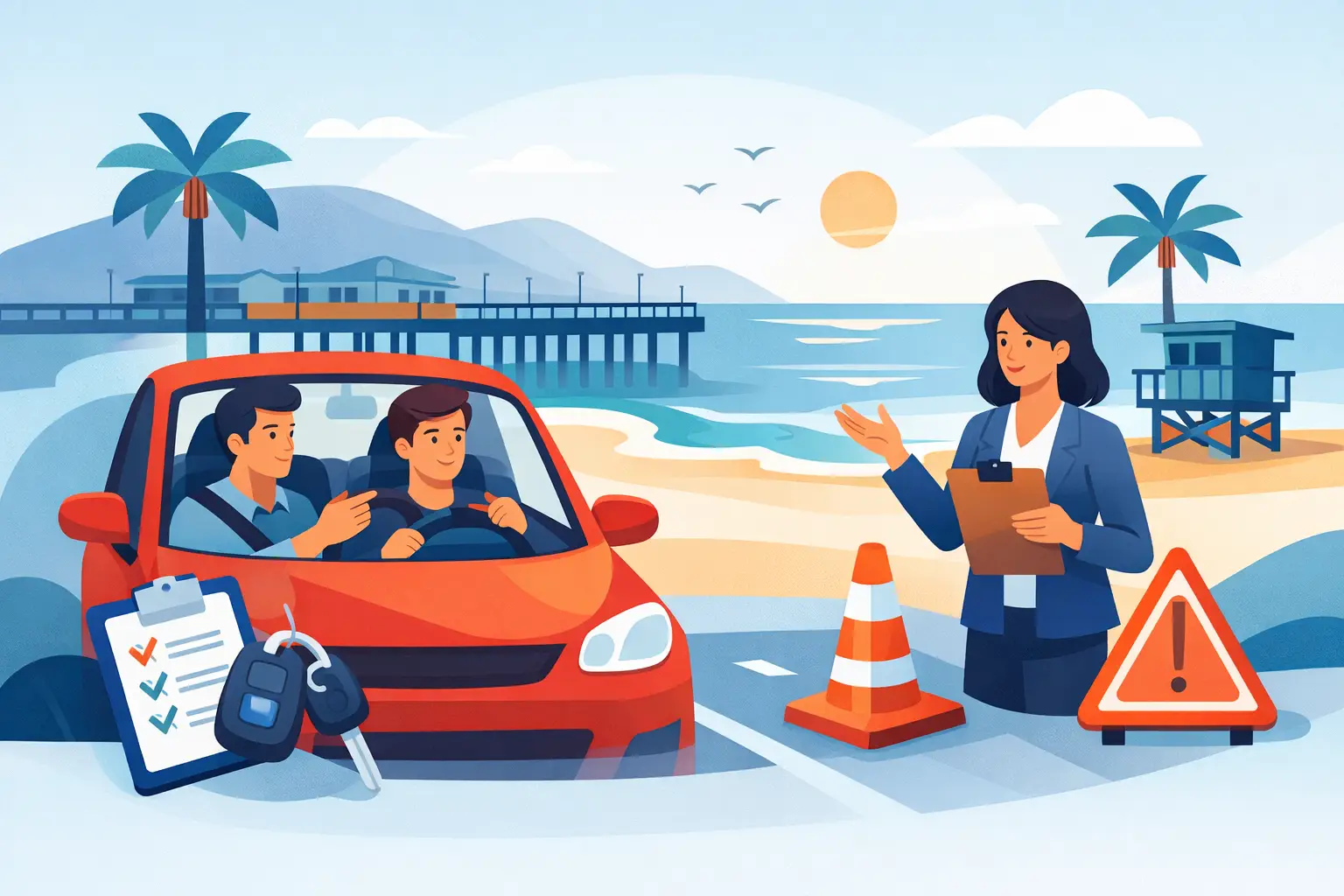
A first drive near Redondo Beach can ask a lot of a new driver at once: residential streets with children and parked cars, busy arterials, changing traffic patterns near schools, and the focus needed to make calm decisions at every intersection. Families looking for serving Redondo Beach driver education and driving lessons need more than time behind the wheel. They need a clear, patient path from learning the rules to driving safely and confidently on their own.
For teens, that path usually begins long before the DMV road test. For adult beginners, returning drivers, and seniors, it may begin with rebuilding comfort in situations that have felt stressful for years. The right instruction meets the student where they are, then builds skill one repeatable step at a time.
Redondo Beach Driver Education and Driving Lessons With a Purpose
Driver education and behind-the-wheel lessons serve different but equally important roles. Online driver education gives new drivers the foundation: California traffic laws, signs, right-of-way rules, the risks of distracted or impaired driving, and the responsibilities that come with a license. Behind-the-wheel training turns that knowledge into habits.
A student may understand that they should check mirrors before changing lanes, for example, but still need coaching to scan mirrors early, signal with enough time, check blind spots, maintain a steady speed, and move only when the lane is clear. That sequence becomes safer through practice, not through memorizing a handbook alone.
For teens under 18, California licensing requirements generally include completing approved driver education, obtaining a learner's permit, receiving professional behind-the-wheel instruction, and logging supervised practice with a parent, guardian, or other qualified adult. The state has specific hour and timing requirements, so families should confirm current DMV rules as they plan. Professional lessons help make those home-practice hours more productive because students start with a consistent method for steering, braking, scanning, and responding to traffic.
Start With the Student's Real Experience Level
No two learners need the same first lesson. A teen who has never driven may need time to get comfortable with the seating position, pedal control, mirrors, turn signals, and basic steering. An adult who drove years ago may already understand vehicle control but feel uneasy merging, parking, or navigating busy streets. A senior driver may want patient feedback on visual scanning, lane position, or adapting to newer vehicle features.
A thoughtful instructor begins by observing rather than assuming. Is the student braking too late? Looking too close to the front of the vehicle? Hesitating at unprotected turns? Becoming flustered after a small mistake? Those observations shape the lesson plan.
Progress should feel paced, but it should also be purposeful. A learner who is nervous does not benefit from being rushed into difficult traffic before basic control is steady. At the same time, remaining only on quiet streets can create a false sense of readiness. Good instruction gradually introduces more complex environments as the student demonstrates safe habits.
What Behind-the-Wheel Lessons Should Cover
Private driving lessons provide the focused repetition that is difficult to create casually. The goal is not simply to drive around for a set number of hours. It is to practice the decisions that drivers must make independently.
Early lessons often concentrate on smooth starts and stops, controlled turns, lane position, intersection approach, backing, and parking. As confidence grows, students can work on lane changes, larger roads, traffic flow, left turns, freeway entry and exit, and defensive driving strategies. The exact order depends on the student. Someone with solid vehicle control may be ready for more complex traffic sooner, while another learner may need more practice with basic observation and speed control first.
Parking deserves more attention than many students expect. It tests slow-speed control, awareness of curbs and surrounding vehicles, and the ability to stay calm while performing several steps in sequence. Parallel parking, curb parking, backing in a straight line, and safe parking-lot navigation are practical skills, not just test items.
Students should also learn how to recover from ordinary driving errors. Missing a turn, choosing the wrong lane, or receiving a horn from another driver does not need to turn into panic. Safe drivers keep their attention forward, avoid abrupt corrections, and make the next legal, calm decision. That mindset is particularly valuable for nervous new drivers.
Preparing for the DMV Road Test Without Teaching to the Test
A DMV road test is an important licensing milestone, but passing it should be the result of safe driving habits, not a last-minute collection of tricks. Test preparation is most useful when it identifies specific areas that still need attention.
A practice evaluation can reveal patterns such as incomplete stops, inconsistent mirror checks, wide turns, late signaling, poor speed control, or uncertainty at intersections. From there, lessons can focus on correction through repetition. For example, a student who stops too far into an intersection may need to practice recognizing stop-limit lines and choosing a proper stopping position in different street layouts.
It also helps to practice under conditions that feel realistic. A student who only drives in light traffic may be surprised by a busy afternoon route. A student who only practices in perfect weather may need extra coaching when visibility changes. The point is not to make lessons unnecessarily stressful. It is to make independent driving feel familiar enough that the student can think clearly.
For families scheduling a DMV test, practical details matter too. Students should know the vehicle's basic controls, arrive with required documents, and use a properly insured, safe vehicle. DMV drive-test support can reduce logistical stress when it is available, particularly for students whose household vehicle is unavailable or unsuitable for the appointment.
How Parents Can Support Practice at Home
Professional instruction works best alongside calm, consistent supervised driving practice. Parents and guardians do not need to teach every skill exactly as an instructor does, but they can reinforce the same safety-first habits.
Before each drive, agree on one or two goals. That might be smooth braking and complete stops, or early mirror checks before lane changes. Giving too many corrections at once can overwhelm a learner, especially early on. After the drive, ask the student what felt easier and what still felt uncertain. This helps turn practice into a conversation instead of a stressful performance review.
It is also wise to vary the practice environment gradually. Begin in lower-pressure areas when necessary, then add busier streets, unfamiliar routes, parking lots, dusk driving, and freeway practice as skills improve. The trade-off is that more challenging conditions create more opportunities to learn, but only when the student has enough foundational control to handle them safely.
Consistency matters more than marathon sessions. A focused drive several times a week often builds confidence better than a long, exhausting session once a month. Students retain more when they can revisit a skill soon after receiving feedback.
Options for Adults, Seniors, and Manual-Transmission Learners
Driving education is not only for teens. Adult beginners may be learning because work, family responsibilities, or a move to the South Bay has made driving necessary. Returning drivers may have a valid license but lack confidence after a long break. These students often appreciate private lessons because they can focus on their actual concerns without feeling compared to younger drivers.
Senior instruction should be respectful and practical. The goal is not to assume that age determines ability. It is to give drivers a comfortable setting to refresh skills, address specific changes in confidence or mobility, and receive clear feedback on safe driving choices.
Manual-transmission lessons require their own pace. Learners need to coordinate the clutch, accelerator, brake, shift pattern, and vehicle movement without losing attention to traffic. Starting in a controlled area is appropriate, then advancing to stops, hills, turns, and normal roadway driving once clutch control becomes more natural. The process can take longer for some students, and that is expected.
With more than 35 years of local instructional experience, South Bay Driving School approaches every lesson as an opportunity to build safer habits, not simply to check off a requirement. Online education, private training, package options, and convenient scheduling can help families organize each step around the learner's needs.
A capable driver is not someone who never feels nervous. It is someone who knows how to observe, prepare, make safe choices, and recover calmly when the road becomes unpredictable. That confidence is built one careful drive at a time.