
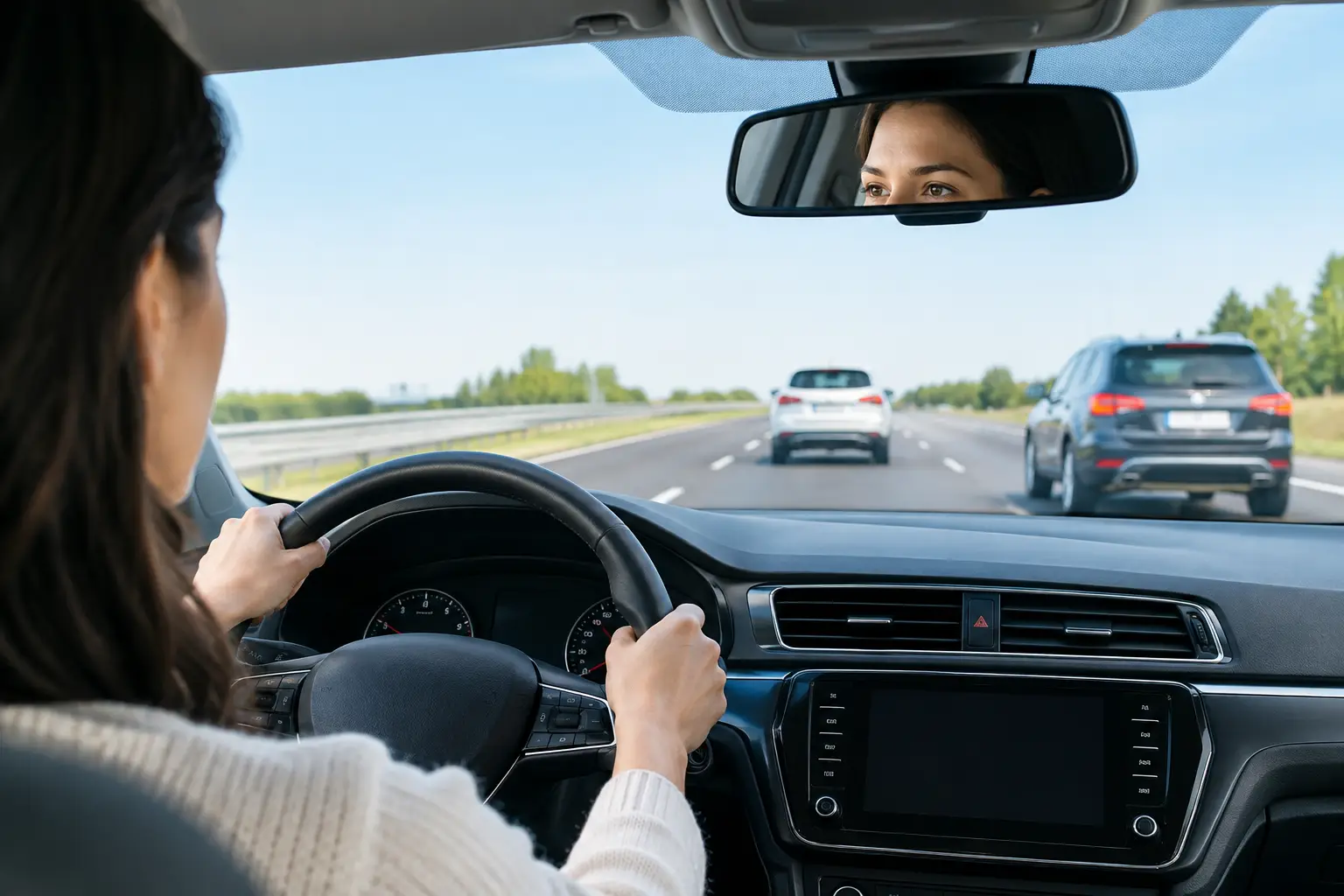
A lane change can take only a few seconds, but those seconds require more awareness than many new drivers expect. To practice safe lane changes, you need more than a quick glance in the mirror. You need a calm, repeatable routine that helps you see traffic clearly, communicate your intention, and move only when the space is genuinely safe.
For teen drivers, the pressure often comes from traffic moving quickly behind them. For adult beginners, returning drivers, and seniors, the challenge may be uncertainty about judging speed and distance. The good news is that lane changes are a skill, not a guess. With patient practice, the process becomes more natural without becoming careless.
Why lane changes require your full attention
A lane change puts your vehicle into the path of cars, motorcycles, bicycles, and sometimes large trucks that may be difficult to see or judge correctly. Mirrors show a great deal, but they do not show everything. Every vehicle has blind spots, and a driver who relies on mirrors alone can miss a road user traveling beside the rear corners of the car.
Speed also changes the situation quickly. On a busy freeway near Torrance or on a multi-lane boulevard in the South Bay, a space that looks open can close in a moment. A vehicle in the next lane may be approaching faster than it appears, especially if it is small, a motorcycle, or partly hidden by another car.
The goal is not to force your way into an opening. The goal is to identify a safe gap, make your intention clear, and move smoothly when traffic allows. If the opening disappears, staying in your current lane is the safe decision. Missing a turn or exit is inconvenient. Making a rushed lane change can be dangerous.
The routine to practice safe lane changes
A reliable lane change follows the same basic order each time: check traffic ahead, check mirrors, signal, check the blind spot, then move gradually if the lane is clear. Practicing this sequence in order helps prevent the common mistake of looking only at the lane beside you while your own lane slows down.
Start by checking what is ahead
Before looking over your shoulder, look forward. Keep a safe following distance and make sure the vehicle ahead is not braking, turning, or slowing for congestion. Drivers sometimes become so focused on finding an opening that they drift toward the car in front of them.
Maintain your speed when reasonable, but do not accelerate suddenly just to get into another lane. A slight speed adjustment may be appropriate to match the flow of the lane you want to enter. The right choice depends on traffic. In some situations, especially heavy freeway traffic, it is safer to wait for a larger gap rather than trying to fit into a tight one.
Check mirrors for the full traffic picture
Use the rearview mirror to understand what is happening behind your vehicle and the side mirror on the direction of your intended move to check the adjacent lane. Look for vehicles that may be approaching from behind, already traveling alongside you, or preparing to pass.
Mirrors are for gathering information, not for giving permission to move. Their view is limited. A vehicle may be beside you but just outside the mirror's field of view. This is why the next step matters every time, even on a familiar road.
Signal before you move
Turn on your signal early enough to give other drivers time to respond. Signaling is communication, not a claim to the lane. Other drivers may make room for you, maintain their position, or continue past you. You still must wait until there is a safe opening.
Avoid signaling and immediately steering at the same time. That gives surrounding drivers little warning and makes your move look unpredictable. A brief pause after signaling lets you recheck traffic and shows you whether another driver is also moving toward the same space.
Make a quick blind-spot check
After checking mirrors and signaling, briefly turn your head toward the lane you plan to enter. This shoulder check should be quick enough that you do not stop watching the road ahead for too long. You are looking specifically for anything that may not appear in the mirror, including a motorcycle, bicycle, or vehicle traveling beside you.
New drivers sometimes either skip this step or turn their head for too long. Both habits create risk. Practice a short, purposeful glance with an instructor or experienced supervising driver until it feels controlled. Your hands should remain steady, and your vehicle should continue straight while you check.
Move over gradually and keep scanning
If the lane is clear, steer smoothly into it. Do not jerk the wheel, cut sharply in front of another vehicle, or cross multiple lanes in one movement. Complete one lane change at a time, then reassess traffic before making another.
Once centered in the new lane, cancel your signal if it has not turned off automatically. Return your focus to the road ahead, check your spacing, and continue scanning mirrors. A lane change is complete only when your vehicle is settled safely in the lane.
How to judge a safe gap
There is no single number of car lengths that works in every lane change. A safe gap depends on your speed, the speed of surrounding traffic, weather, visibility, and the size of the vehicles involved. A gap that feels comfortable on a quiet street may be too small at freeway speed.
As a practical rule, you should be able to enter the lane without causing the driver behind you to brake suddenly or swerve. You also need enough room ahead so you are not following the vehicle in front too closely as soon as you move over. If you are wondering whether the gap is large enough, it often is not the right gap yet.
Be especially cautious around large trucks. Their size can make it harder to judge distance, and their blind spots are much larger than those of a passenger car. Do not linger beside a truck when possible, and never move into a space that requires you to cut closely in front of it.
Common lane-change mistakes and better choices
The most common error is changing lanes because a driver feels pressured by the vehicle behind them. Tailgating is frustrating, but it is not a reason to make an unsafe move. Keep your lane, maintain appropriate speed, and wait for a safe opening.
Another frequent mistake is treating a turn signal as permission. A signal tells others what you intend to do. It does not mean another driver must yield the space. Continue checking until you can move without interfering with traffic.
Drivers also make mistakes when they focus on one car and overlook the rest of the lane. For example, you may see a large opening behind one vehicle but fail to notice a motorcycle approaching in the blind spot. Use mirrors, signal, and shoulder check as one connected process.
Finally, avoid last-second lane changes for an exit, turn lane, or parking entrance. Plan ahead by reading signs early and moving into the appropriate lane with time to spare. If you miss the turn, continue safely and choose another route. That is a responsible driving decision, not a failure.
Practice in stages before busy traffic
Start in a low-pressure setting. A wide, lightly traveled street gives you time to practice mirror checks, signaling, and smooth steering without fast-moving freeway traffic. At first, the goal is not to change lanes often. The goal is to complete the routine correctly every time.
Next, practice on roads with moderate traffic where you need to judge real gaps and communicate with other drivers. When you are ready, freeway practice can help you learn how speed affects spacing, especially during merging, passing, and preparing for exits.
A parent or supervising driver can help by giving calm, specific feedback. Instead of saying, “Be careful,” identify the habit to improve: “Signal earlier,” “Check your blind spot after the mirror,” or “Wait for a larger space.” Clear feedback gives a learner something useful to repeat.
Professional behind-the-wheel instruction can be particularly helpful for nervous drivers or anyone who has not driven in a while. At South Bay Driving School, instructors can break lane changes into manageable steps and help students practice at a pace that builds confidence without rushing the skill.
Stay patient when conditions change
Rain, glare, darkness, construction zones, and heavy traffic all change what a safe lane change looks like. In these conditions, increase following distance, signal earlier, and give yourself more time to find an opening. If another driver is driving aggressively, do not respond by speeding up or competing for a lane.
The strongest lane-change habit is patience. Keep your routine consistent, wait for a safe gap, and let the road situation guide your decision. Every time you choose control over urgency, you are building the judgment that makes confident drivers safe drivers.