
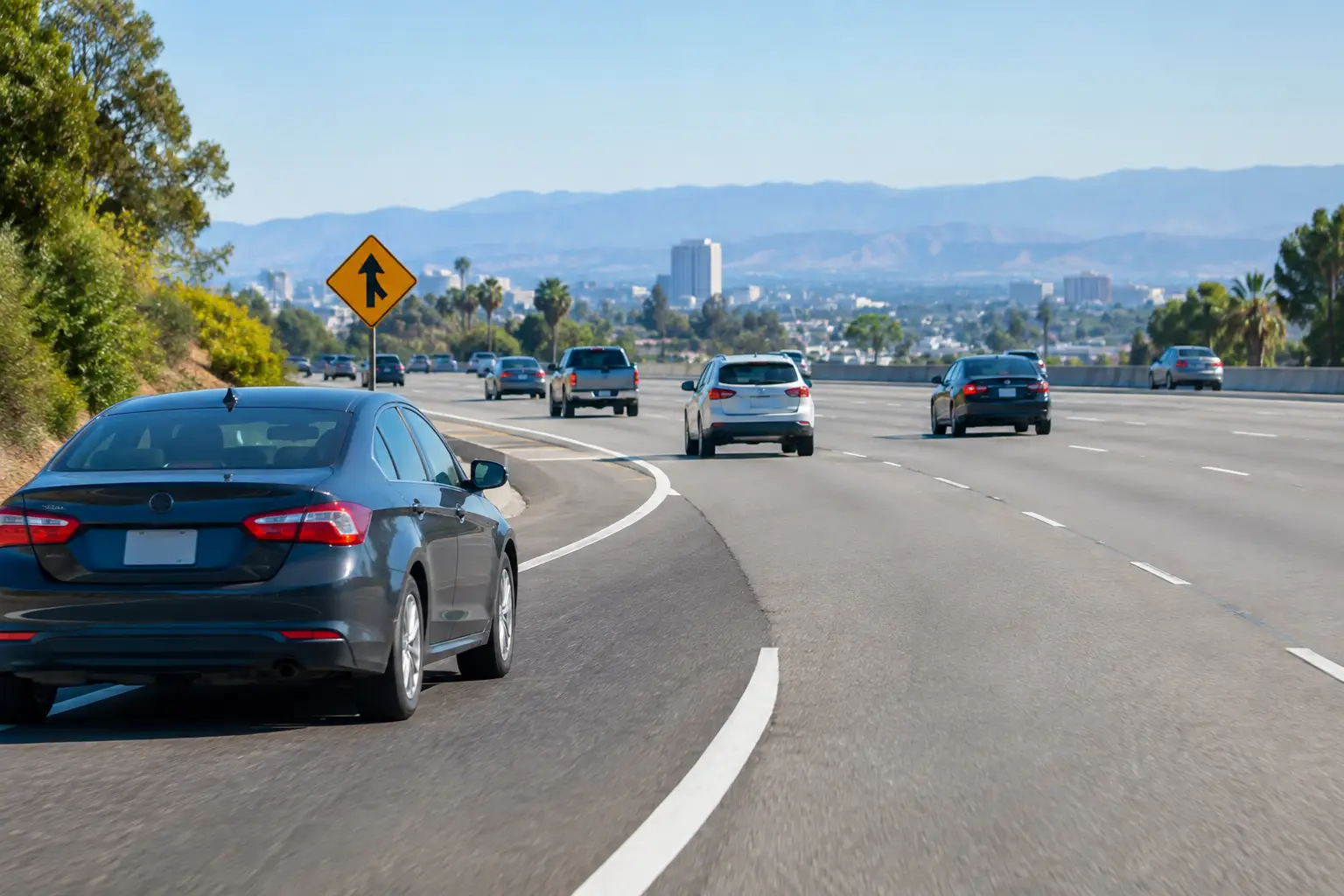
A freeway entrance can feel rushed, especially when traffic is moving at 65 mph and the on-ramp seems to disappear ahead of you. The good news is that learning to merge safely onto freeways is not about being aggressive or waiting for a perfect opening. It is a repeatable process: build appropriate speed, read traffic early, choose a space, communicate clearly, and join the flow without forcing another driver to react.
For new drivers in the South Bay, freeway merging is often one of the last skills to feel comfortable. Busy routes such as the 405, 110, 105, and 91 can bring fast traffic, short ramps, and drivers who may not leave much room. Patient practice turns that pressure into a skill you can use every day.
What a Safe Freeway Merge Really Means
A safe merge means entering the freeway at a speed close to the traffic already on it, while moving into an available space without causing another driver to brake sharply, swerve, or change lanes. You are responsible for finding a safe gap and adjusting your speed to fit into it.
That does not mean every merge happens at exactly the posted freeway speed. Traffic may be slow, stopped, or moving unevenly. Weather, visibility, ramp length, and the vehicles around you all matter. Your goal is to match the actual flow as closely as conditions allow.
Many nervous drivers make one of two mistakes: they enter too slowly because fast traffic feels intimidating, or they focus so closely on the lane beside them that they stop looking ahead. A safe merge requires both forward vision and awareness of the lane you are joining.
How to Merge Safely Onto Freeways Step by Step
Build speed on the entrance ramp
The entrance ramp is an acceleration lane, not a place to wait for freeway traffic to clear. As soon as the ramp allows, begin accelerating smoothly. Look well ahead to follow the curve, but start checking the freeway traffic pattern early.
If freeway traffic is moving near 60 mph and you reach the merge area at 35 mph, vehicles behind you may have to brake hard or change lanes unexpectedly. Accelerating to a similar speed gives you more choices and makes your movement predictable.
Do not confuse smooth acceleration with flooring the gas pedal. The goal is controlled speed, with enough power to adjust if you need to fit behind or ahead of a vehicle. A trained instructor can help a new driver learn how much acceleration their particular car needs.
Scan early and choose a gap
Before you reach the end of the ramp, look ahead for a usable opening in the right lane. Check your inside mirror, outside mirror, and the traffic through the side windows. You are looking for the space between two vehicles, not staring at one vehicle and hoping it moves.
A good gap gives you room to enter without crowding the vehicle ahead or cutting closely in front of the vehicle behind. If the space you first notice is closing, keep scanning. Often, adjusting your speed slightly will help you fit naturally into the next opening.
Look for where traffic is headed, not just where it is at this moment. A car that appears far behind can approach quickly at freeway speed. A vehicle with a turn signal may be planning to exit or move into your lane. Reading these details early gives you more time to make calm decisions.
Signal, check your blind spot, and move once
Turn on your signal before moving toward the freeway lane. Signaling does not give you the right-of-way, but it tells other drivers what you plan to do and may encourage a cooperative driver to create room.
After checking your mirrors, make a brief shoulder check toward the lane you are entering. Mirrors do not show every vehicle, motorcycle, or car traveling beside your rear quarter panel. Keep the shoulder check quick so you can return your eyes to the road ahead.
When the space is open, steer smoothly into the lane. Avoid drifting slowly across the lane line while you debate the decision. A clear, steady movement is easier for surrounding drivers to understand. Once fully in the lane, cancel the signal if needed and create a safe following distance from the vehicle ahead.
Adjust Speed Instead of Stopping
When drivers feel uncertain, they may brake at the end of the ramp and wait. On most California freeway ramps, stopping is risky unless traffic conditions leave no other safe option. It can surprise drivers behind you and leave you trying to accelerate from a standstill into fast-moving traffic.
Instead, use small speed adjustments. If a gap is ahead of you, accelerate enough to reach it. If a gap is behind you, ease off the accelerator early and let the vehicle beside you pass. Planning this adjustment before the ramp ends is much safer than making a sudden decision at the merge point.
There are exceptions. If traffic is stopped, the ramp is blocked, or no safe entry is available, you may need to slow or stop. In that situation, leave room ahead when possible so you can begin moving before the freeway opens. Never force your way into a space that is too small simply because the ramp is ending.
Common Merging Mistakes to Avoid
New drivers do not need to be perfect. They do need to recognize habits that can make freeway entry less safe.
- Entering much slower than traffic: This reduces your ability to blend into the lane and can create a speed difference that other drivers must manage.
- Looking only in mirrors: Mirrors are useful, but they cannot replace a quick blind-spot check before moving laterally.
- Forcing another driver to brake: A turn signal is a request, not permission to take a gap that is not there.
- Fixating on the vehicle beside you: Continue looking ahead so you can follow the ramp, judge distance, and notice traffic slowing in front of you.
- Stopping unnecessarily at the ramp’s end: When safe, use the acceleration lane to adjust speed and merge with the flow.
Another common issue is merging directly into the left lane because the driver is thinking about an upcoming freeway change. Start in the right lane unless traffic conditions make that impossible. After you are established in the lane and have checked your mirrors and blind spot again, change lanes one at a time when it is safe.
Handling Short Ramps and Heavy Los Angeles Traffic
Not every freeway entrance gives you a long, straight acceleration lane. Some ramps in and around Torrance, Carson, Gardena, San Pedro, and the beach cities are short, curved, or affected by heavy traffic. These conditions require earlier observation and more deliberate speed control.
On a short ramp, begin scanning freeway traffic as soon as you can see it. You may need to decide whether to accelerate toward a space ahead or ease off to enter behind a vehicle sooner than you would on a longer ramp. Keep the steering smooth. A curved ramp can make drivers feel like they need to look sideways for too long, but your primary visual focus should still return to the road ahead.
In congestion, merging is usually slower and may involve a more visible give-and-take between drivers. Keep your signal on, leave enough room to react, and look for a driver who has created a usable opening. Even when traffic is crawling, do not move into a lane without confirming that the space is truly clear.
Practice Builds the Right Habits
Freeway driving becomes less stressful when the sequence is familiar: accelerate, scan, signal, check, adjust, and merge. Begin practice during lower-traffic times with an experienced licensed driver or qualified instructor. Repeating the same type of entrance a few times can help you learn the timing without adding the pressure of an unfamiliar route.
It also helps to practice both situations: merging ahead of a vehicle and merging behind one. Drivers who only practice one pattern may feel stuck when traffic requires the other choice. With guided behind-the-wheel practice, students can receive calm feedback on speed, spacing, mirror use, and lane position while the situation is still fresh.
South Bay Driving School teaches freeway skills as part of real-world driving readiness, not as a one-time maneuver to memorize. The goal is to help drivers make safe decisions independently, whether they are headed to school, work, the beach, or a DMV road test.
The next time an on-ramp comes into view, give yourself permission to plan early rather than panic late. A steady approach, the right speed, and one clear decision can make the freeway feel far more manageable.