
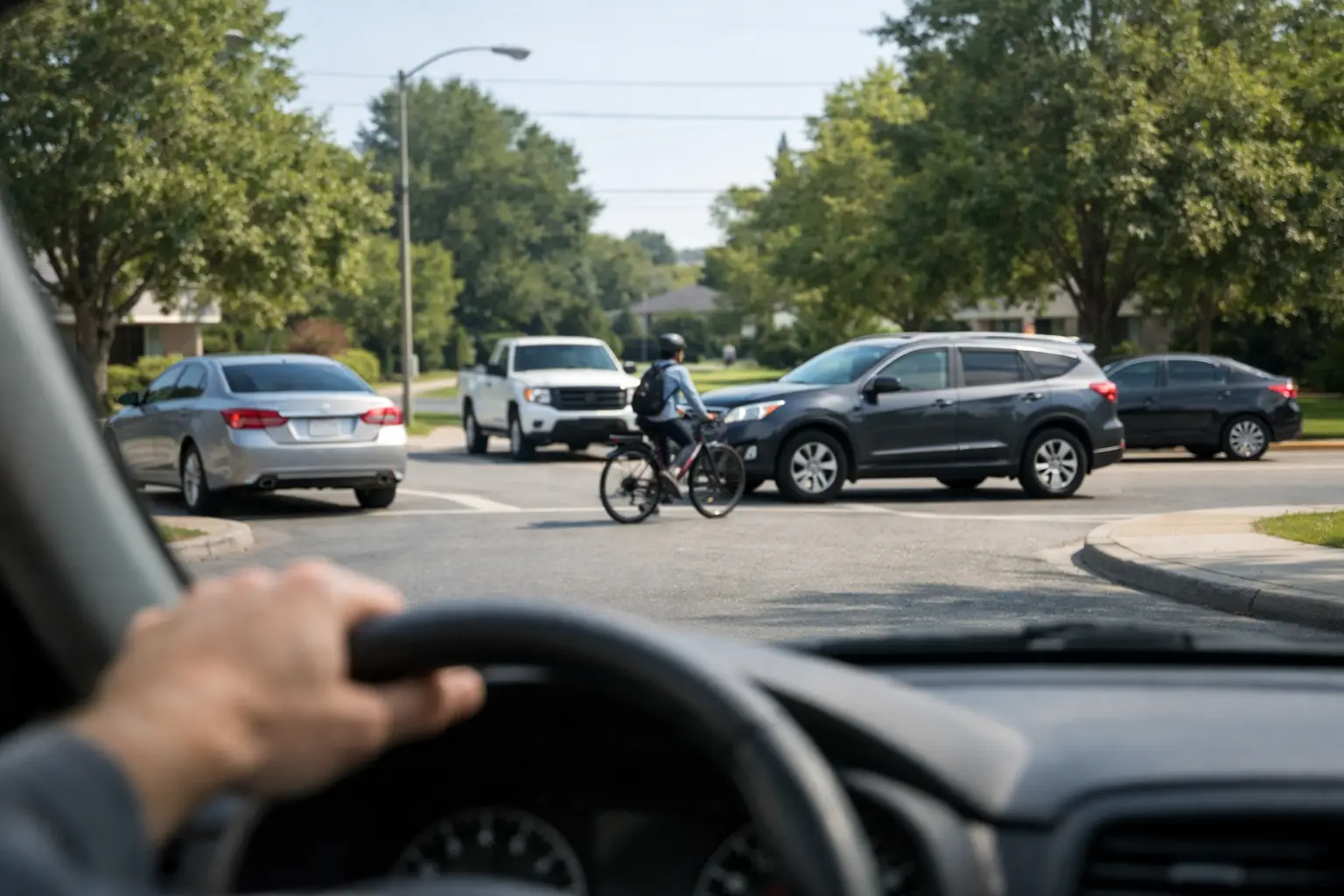
A four-way stop can feel simple until four vehicles arrive within seconds of each other. For new drivers, that brief pause can create a lot of pressure: Who goes first? What if another driver waves you through? What happens when a pedestrian steps into the crosswalk? Knowing how to handle four way stops calmly is an essential skill for everyday driving and for the California DMV road test.
The goal is not to rush through the intersection. It is to make a complete stop, identify every road user, apply the right-of-way rules, and move only when the path is clearly safe. With practice, the process becomes predictable.
Start With a Complete Stop
Every driver approaching a stop sign must come to a full stop. Your vehicle should stop before the limit line. If there is no visible limit line, stop before the crosswalk. If there is neither, stop at a point where you can see traffic clearly without entering the intersection.
A rolling stop may feel minor, especially on a quiet residential street, but it creates real risk. It also signals uncertainty to other drivers. A complete stop gives you time to look left, right, and ahead for vehicles, bicycles, pedestrians, and other hazards.
At many South Bay intersections, parked cars, landscaping, and larger vehicles can limit your view. If your sightline is blocked after stopping, creep forward slowly only after making the initial full stop. Continue checking for cross traffic as you improve your view.
The First Vehicle to Stop Goes First
The basic rule at a four-way stop is straightforward: the first vehicle to come to a complete stop has the right-of-way to proceed first.
Watch the order in which vehicles arrive, not simply which one appears closest to the intersection. A driver who stops first on the opposite side should go before a driver who arrives a moment later, even if that second driver is turning right.
This is why it helps to pay attention as you approach the intersection rather than waiting until your own vehicle is stopped. You do not need to stare at other drivers. Simply notice who is already waiting and who stops after you.
If you are clearly the first vehicle to stop, proceed when the crosswalk and intersection are clear. Do not wait so long that you confuse other drivers about your intention. Safe driving includes being predictable.
When Two Vehicles Stop at the Same Time
Sometimes two vehicles arrive at the same time. In that case, the driver on the left yields to the driver on the right.
For example, if you and another vehicle stop at the same moment, and that vehicle is to your right, let that driver go first. If you are on the right, you may proceed first once you have confirmed that the way is clear.
This rule works well in most situations, but do not treat it as a reason to force your way forward. Another driver may not understand the rule, may be distracted, or may believe they arrived first. If there is any doubt, wait. Giving up a few seconds is always better than entering an unsafe intersection.
Opposing Vehicles Need Extra Attention
When vehicles are directly across from one another, both may be able to proceed at the same time if their paths do not cross. For instance, two vehicles going straight can usually move through together. A vehicle turning right and an opposing vehicle going straight can also often proceed at the same time, as long as there are no pedestrians or bicycles in conflict.
The situation changes when one driver is making a left turn. A left-turning driver must yield to oncoming traffic that is going straight or turning right. If you are turning left, wait until the opposing vehicle has cleared the intersection before completing your turn.
Do not rely on another driver’s turn signal alone. Signals can be left on accidentally or activated too late. Watch the vehicle’s position, speed, and direction before deciding it is safe to go.
Pedestrians and Bicyclists Come First
At a four-way stop, drivers often focus so much on other cars that they miss the person in the crosswalk. Before moving, scan the crosswalk in front of you and the crosswalk you will cross during a turn.
Pedestrians have the right-of-way in a marked or unmarked crosswalk at an intersection. Wait until they have safely cleared your path before proceeding. Be especially careful near schools, shopping areas, neighborhood parks, and beach communities where people may cross unexpectedly.
Bicyclists can also be difficult to judge because they may approach quietly and travel faster than expected. Treat a bicyclist as a road user who deserves the same careful attention as a vehicle. Never pull forward because you assume they will stop or move out of your way.
How to Handle Four Way Stops When Drivers Hesitate
The written rules are clear, but real intersections are not always perfectly organized. One driver may stop too far back, another may wave everyone through, and someone else may hesitate after having the right-of-way.
In these moments, use patience and clear communication. Make eye contact when possible, but do not depend on eye contact alone because tinted windows, glare, or distraction can make it unreliable. Watch for vehicle movement. If another driver begins moving, let them continue instead of competing for the same space.
A small hand wave can be helpful when it confirms what is already safe and obvious. It should not replace the right-of-way rules. Avoid waving another driver into traffic when you cannot see all lanes or crosswalks. You may be able to see a hazard that they cannot, and they may assume your signal means the entire intersection is clear.
If everyone is waiting, take a moment to reassess. Identify who likely arrived first. If that remains unclear, allow the driver on your right to proceed. If another driver moves first, let them go and restart the process. There is no prize for being first through the intersection.
Common Four-Way Stop Mistakes
New drivers often make mistakes not because they do not know the rule, but because they try to make a decision too quickly. The most common problem is following the vehicle ahead too closely. If the car in front of you goes through the stop sign, that does not mean you can follow without stopping. You must make your own complete stop.
Another mistake is stopping while focused only on the vehicle directly across from you. Traffic can come from all directions, including bicycles approaching from the side and pedestrians stepping off the curb. Build a repeatable scan: left, right, ahead, crosswalks, then check your intended path before moving.
Some drivers also enter the intersection while still undecided. Avoid creeping into the middle of the intersection to claim your turn. Wait behind the line until you know it is your turn and you have a safe opening. Once you decide to proceed, accelerate smoothly and complete your movement without unnecessary delay.
Finally, do not let a driver behind you pressure you with a horn. A horn does not change who has the right-of-way, and it does not make an unclear intersection safe. Stay focused on the road, not on the impatience of another motorist.
Practice the Same Routine Every Time
Confidence at four-way stops comes from using the same routine repeatedly. As you approach, slow down early and check mirrors. Make a full stop at the correct location. Look for pedestrians, bicycles, and vehicles. Determine who arrived first, then apply the rule that the driver on the left yields to the driver on the right when vehicles arrive together.
During behind-the-wheel instruction, it is useful to practice at quieter intersections before moving to busier areas. A patient instructor can help you identify arrival order, anticipate conflicts, and learn when it is appropriate to proceed. That kind of practice is especially valuable for teen drivers, adult beginners, and returning drivers who feel anxious making quick decisions.
A DMV examiner is looking for safe observation, full stops, proper right-of-way decisions, and controlled vehicle movement. They do not expect you to force your way through a confusing situation. When the intersection is uncertain, cautious judgment is the correct choice.
The next time you approach a four-way stop, give yourself permission to pause, observe, and decide. A few calm seconds spent reading the intersection can protect everyone around you and help make confident driving feel natural.