
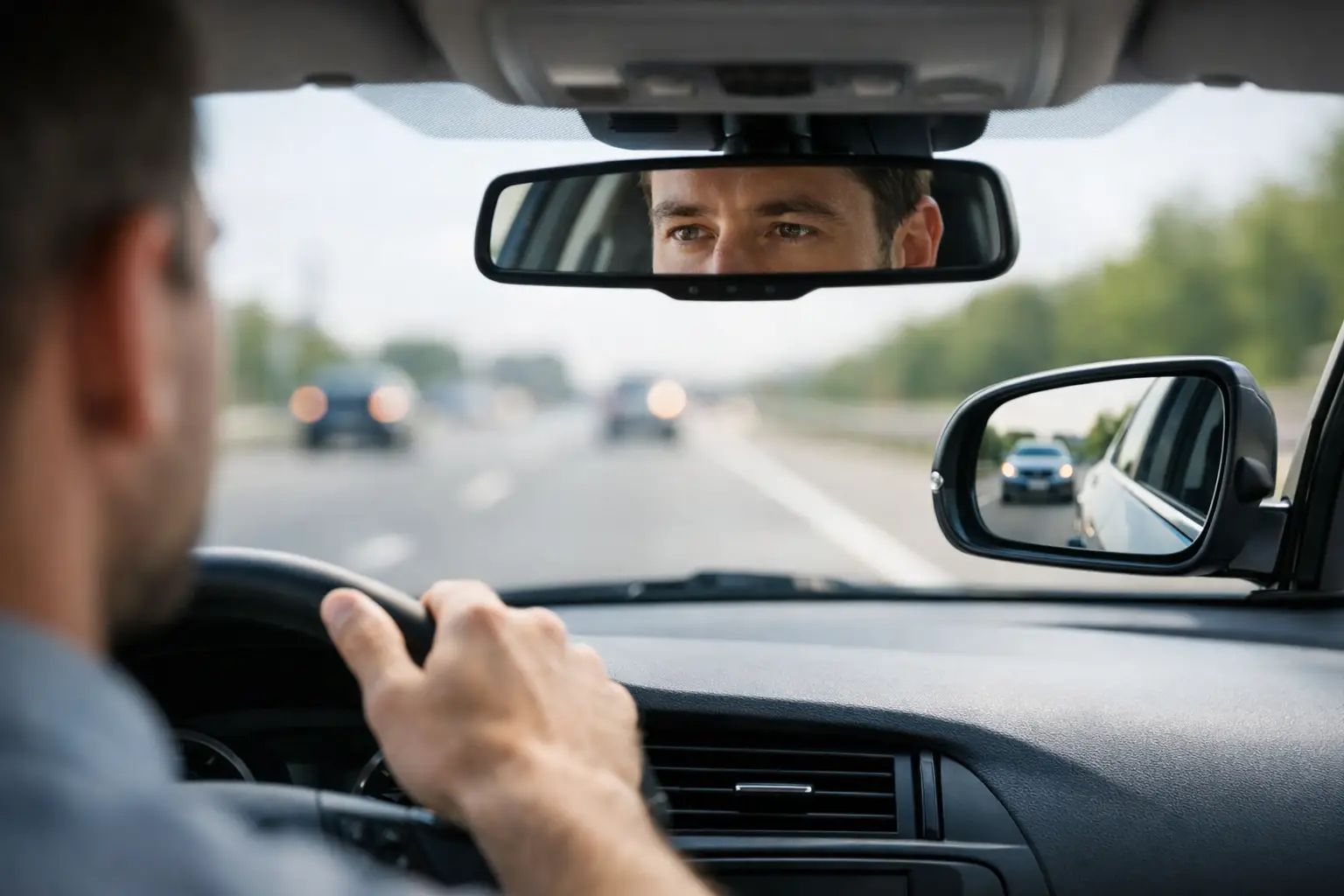
A mirror check should take less than a second, but it can tell you whether a lane change is safe, whether someone is following too closely, or whether a child on a bike has entered the space behind your car. For new drivers, the hard part is not knowing that mirrors matter. It is learning how to check mirrors driving without staring at them, drifting in your lane, or forgetting the blind spot.
The goal is not to constantly look at every mirror. Safe drivers develop a calm scanning pattern that keeps them aware of traffic while their eyes remain primarily focused ahead. With practice, mirror checks become as natural as easing off the gas when traffic slows.
Set Your Mirrors Before the Car Moves
Good mirror habits start before you shift into drive. Adjust the driver’s seat first, including the seatback, height, and distance from the pedals. If you change your sitting position after adjusting the mirrors, the view changes too.
Your rearview mirror should frame the entire rear window as much as possible. You should be able to glance at it without moving your head far from its normal driving position. It is meant to show the traffic directly behind you.
Set each side mirror so you see a small edge of your own vehicle along the inside edge of the mirror, with the road and adjacent lane filling most of the view. Seeing a little of the car gives you a reference point. Seeing too much of the side of your vehicle wastes useful viewing space.
There is no single perfect side-mirror angle for every driver or vehicle. The important thing is to reduce overlap between the rearview mirror and side mirrors while maintaining a clear view of the lanes beside you. Your instructor can help fine-tune the setup for your height and the vehicle you are learning in.
How to Check Mirrors While Driving
Use quick glances, not long looks. A mirror is a source of information, but the road ahead remains your primary responsibility. Looking in a mirror for several seconds can be enough time for the vehicle in front of you to brake, a traffic light to change, or your car to wander within the lane.
A helpful basic rhythm is to check the rearview mirror about every five to eight seconds when traffic is moving. This is not a rigid stopwatch rule. On an open road with no nearby vehicles, you may scan less often. In dense South Bay traffic, near freeway entrances, or when driving around pedestrians and cyclists, you may need more frequent checks.
Each glance should answer a practical question: Who is behind me? Is anyone closing in quickly? Is a vehicle sitting beside me? Is there a cyclist near the curb? Then bring your eyes back to the road ahead.
Think of mirror use as a continuous conversation with the traffic around you. You are building a picture of what is happening behind and beside the car before you need to make a decision.
Before Braking or Slowing
Check the rearview mirror before you brake firmly or slow significantly, especially for a yellow light, heavy traffic, a turn, or a changing speed limit. You are not asking permission to brake. You are checking whether a driver behind you is following closely and may need extra warning.
If someone is close behind, begin slowing earlier and more gradually when conditions allow. Brake lights still communicate your intention, but early, smooth braking gives the following driver more time to react. Keep a safe following distance ahead so you have room to slow without a sudden stop whenever possible.
Before Turning or Pulling to the Curb
For a right turn, check the rearview mirror and right-side mirror early. Look specifically for bicycles, e-bikes, scooters, motorcycles, and pedestrians approaching the corner. A vehicle may not be in your lane, yet a person can still be traveling through the space you plan to enter.
Before pulling away from a curb, check all around the vehicle. Use the rearview mirror, side mirror, turn signal, and an over-the-shoulder blind-spot check before merging into traffic. Mirrors give you an initial view. They do not show every area around the car.
Before Changing Lanes
A safe lane change has a sequence. First, check the rearview mirror to understand traffic behind you. Next, signal early enough to communicate your plan. Then check the side mirror in the direction you intend to move and perform a brief shoulder check for the blind spot.
Only move over when there is an open space and you can do so smoothly without forcing another driver to brake or speed up. If the lane is crowded, keep your signal on only while you are genuinely waiting for a safe opening. Do not drift toward the line to pressure another driver into making room.
The shoulder check is essential because every mirror setup leaves a blind area. Make it quick and purposeful: turn your head just enough to look through the side window area, then return your eyes forward as you complete the lane change. Avoid a long head turn that takes your attention away from traffic ahead.
When Backing Up
Mirrors are useful when reversing, but they are not the complete answer. Before backing, check around the vehicle for people, pets, low objects, and cross traffic. When backing from a parking space or driveway, turn your body and look through the rear window whenever possible, using mirrors to monitor the sides of the vehicle.
A backup camera is a helpful aid, especially for seeing low objects directly behind the car. It does not replace looking around. Cameras can have distorted distance, limited side views, glare, rain droplets, or a blocked lens. Treat every camera as an extra tool, not as your only source of information.
Build a Scan Pattern That Does Not Overwhelm You
Beginning drivers sometimes try to check every mirror in rapid succession. That can feel busy and distracting. Instead, tie mirror checks to driving events.
For normal driving, use a steady forward view with brief rearview checks. Add side-mirror checks before signaling, turning, merging, changing lanes, pulling out, or moving toward the curb. Increase your scanning when entering a freeway, approaching a busy intersection, passing parked cars, or driving beside bike lanes.
A simple mental cue can help: ahead, behind, beside, then ahead again. The forward view always comes back first. This pattern is especially useful during lessons because it helps an instructor see that you are gathering information before acting.
It also helps to say the reason for the check quietly in your mind: “rearview, slowing,” or “right mirror, bike lane.” That may feel awkward at first, but it connects the mirror glance to a decision rather than making it a random habit.
Common Mirror Mistakes and How to Correct Them
The most common mistake is checking mirrors only when a maneuver is already underway. By then, a driver may discover a car beside them after they have started drifting into the next lane. Check early, then check again immediately before moving.
Another mistake is trusting a side mirror without a shoulder check. Mirrors can make a lane appear clear when a vehicle, motorcycle, or cyclist is hidden in the blind spot. The side mirror and shoulder check work together.
Some drivers stare at the rearview mirror when they are nervous about a tailgater. This takes attention away from the risk ahead. Check the mirror, create more space in front of your vehicle, and let the tailgater pass when it is safe. Do not speed up or brake-check to respond to pressure from behind.
Finally, do not adjust mirrors while driving unless there is an urgent need. Pull over safely if your view is poor. A few seconds of reaching for mirror controls can take your attention from a developing traffic situation.
Practice Mirror Checks in Low-Stress Conditions
Mirror awareness improves through repetition, not through memorizing a rule. Start in a quiet neighborhood or an empty parking area with a licensed instructor or qualified supervising driver. Practice pulling away, stopping, turning, backing, and changing lanes where the pace is manageable.
As your confidence grows, practice on busier streets and then on freeways. The skill changes with the environment. A quiet residential street may require more attention to pedestrians, driveways, and parked cars, while a freeway requires earlier mirror checks because traffic closes gaps quickly.
At South Bay Driving School, instructors help students turn these steps into repeatable habits, rather than simply reminding them to “check your mirrors.” The difference matters: a confident driver knows what to look for, when to look, and what to do with the information.
The best mirror routine is one you can use calmly every time you drive. Start with a properly adjusted seat and mirrors, glance with purpose, check your blind spot before moving sideways, and return your focus to the road ahead. Each safe check is a small decision that gives you more time, more space, and a better chance to protect everyone sharing the road.