
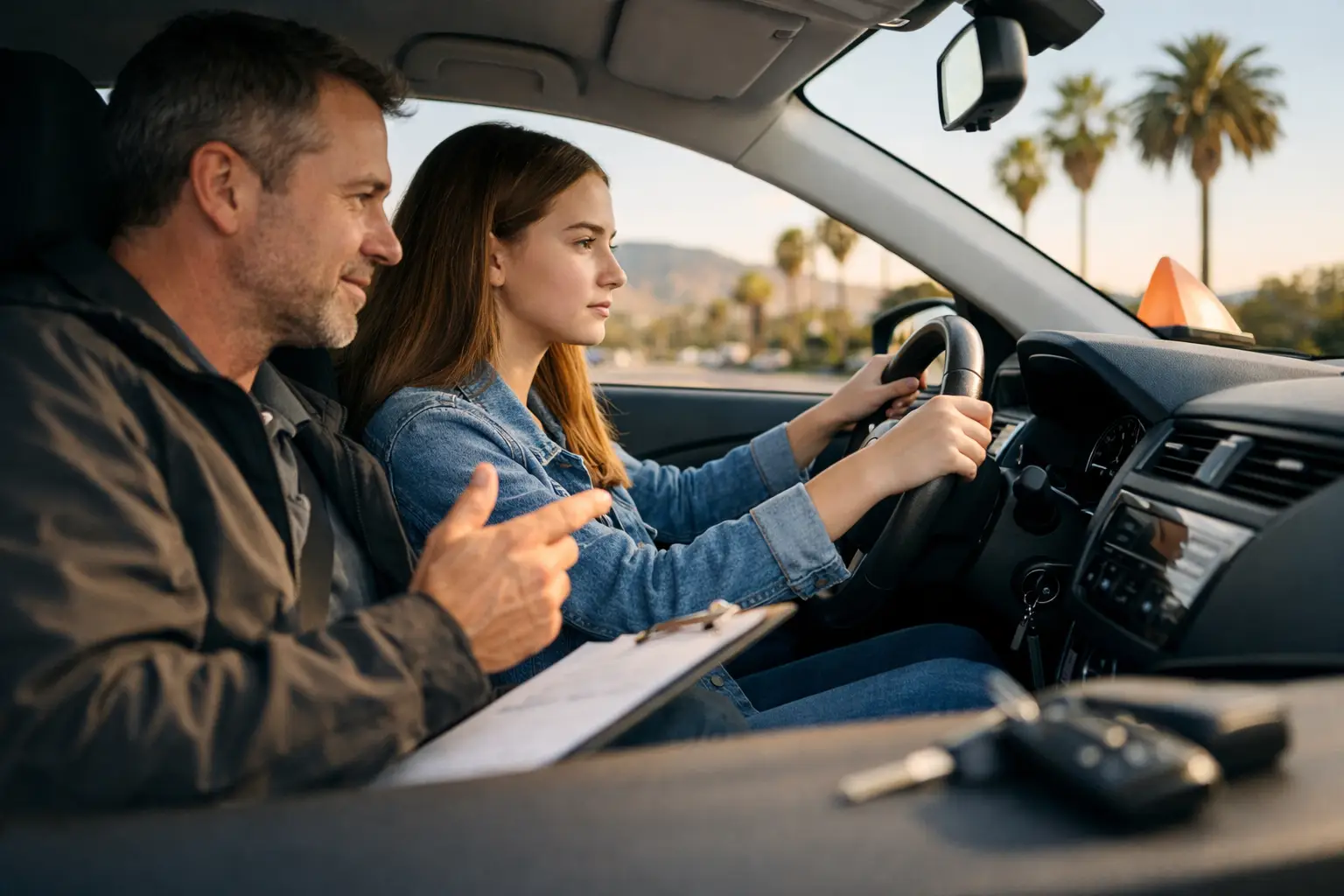
A teen may complete California’s required professional training and still need more time before they feel steady merging onto the 405, navigating a busy Torrance intersection, or parking near a crowded school. So, how many driving lessons do teens need? The legal minimum is a starting point, not a measure of true readiness. Most teens benefit from a combination of professional instruction, consistent supervised practice, and a few targeted lessons before the DMV drive test.
For parents, the goal is not simply to check off required hours. It is to help a new driver develop safe habits that hold up when traffic is moving quickly, a friend is talking in the passenger seat, or an unexpected pedestrian steps into a crosswalk.
How Many Driving Lessons Do Teens Need in California?
California requires drivers under 18 to complete at least six hours of behind-the-wheel training with a licensed driving instructor. This is commonly completed as three two-hour lessons. Teens must also complete 50 hours of supervised practice with a parent, guardian, or another qualified adult age 25 or older, including at least 10 hours at night.
Those requirements are essential, but they are minimums. Six hours gives an instructor time to introduce and evaluate core skills. It rarely gives every student enough repetition to become comfortable in every driving situation they will face independently.
For many teens, six to 10 hours of professional lessons is a practical range. A confident learner who practices regularly between lessons may be prepared with the required six hours plus a road-test preparation lesson. A teen who is anxious, has limited access to a practice vehicle, or needs more work with traffic judgment may benefit from eight, 10, or more hours.
The right number is based on skill and consistency, not age or how quickly another student earned a license.
What the Required Lessons Are Designed to Teach
Professional lessons give teens a structured environment to learn the fundamentals before practice becomes more independent. A patient instructor can correct small habits early, explain California rules clearly, and introduce skills in a logical order.
Early lessons often focus on vehicle familiarity, steering control, braking smoothly, lane position, turns, intersections, mirrors, and scanning for hazards. As a student improves, instruction can move into lane changes, busier roads, parking, backing, freeway driving, and the decisions that make driving safe rather than merely functional.
An instructor is also watching for habits that parents may not always recognize. A teen might make clean turns but fail to check blind spots consistently. They may keep a safe following distance on quiet streets but follow too closely when traffic becomes unpredictable. These are common learning gaps, and they are easier to address with focused feedback than with repeated reminders during a family practice drive.
Professional Lessons and Parent Practice Work Together
Driving school is not meant to replace parent or guardian practice. It makes that practice more productive.
During professional instruction, teens receive direct coaching on technique and decision-making. During supervised practice, they build repetition. Both matter. A student who takes several lessons but only drives occasionally between them may forget skills or remain hesitant. A student who practices often without professional feedback may repeat an unsafe habit until it feels normal.
A useful rhythm is to schedule a lesson, practice the skills from that lesson several times in calm conditions, and then return for the next lesson. For example, after learning controlled turns and intersection checks, a teen can practice those skills on familiar neighborhood routes. Once those actions become routine, an instructor can introduce more demanding traffic situations.
Parents do not need to turn every drive into a lecture. Before leaving, choose one or two skills to watch for, such as complete stops, mirror use, or smooth braking. After parking, ask the teen what felt comfortable and what felt difficult. This helps new drivers learn to assess their own decisions without feeling criticized.
When a Teen May Need More Than Six Hours
More lessons are often helpful when a teen has specific skill gaps or has not had much time behind the wheel. Needing extra instruction is not a failure. It is a responsible choice that can make a major difference once the teen begins driving alone.
Additional training may be worthwhile if the teen:
- Becomes overwhelmed in moderate or heavy traffic
- Hesitates excessively at unprotected turns or four-way stops
- Has trouble maintaining lane position or speed control
- Avoids lane changes, parking, backing, or freeway entrances
- Receives repeated corrections for observation habits, including blind-spot checks
- Has long gaps between practice sessions because of school, sports, work, or family schedules
A few additional lessons can be especially valuable for South Bay teens who have practiced mainly on quiet residential streets. Local driving can quickly include multi-lane roads, fast freeway ramps, complex intersections, cyclists, pedestrians, and coastal traffic. A student should not have to encounter those challenges alone for the first time after receiving a license.
Road-Test Readiness Is Different From Basic Competence
Passing the DMV drive test requires a teen to demonstrate safe, legal, controlled driving. But preparing for the test should not become a narrow exercise in memorizing a route or performing maneuvers only when prompted.
A road-test preparation lesson can help identify the issues that most often cost new drivers points: incomplete stops, weak observation, late signaling, rushed turns, poor lane changes, and failure to adjust speed for conditions. It can also help a teen understand what the examiner is looking for so the test feels less mysterious.
Still, test readiness should rest on everyday driving ability. A teen is likely ready when they can drive a variety of familiar and unfamiliar routes without constant coaching, recover calmly from a minor mistake, follow directions while continuing to scan the road, and make conservative decisions when uncertain.
Confidence matters, but confidence should come from practice rather than pressure. A teen who says, “I can handle that,” after successfully managing several types of driving conditions is in a much better position than one who feels rushed to test because friends have already received their licenses.
A Realistic Training Timeline for Families
California requires a teen to hold an instruction permit for at least six months before applying for a provisional license. That time can be used well when practice is spread out rather than squeezed into the final few weeks.
In the first month, professional instruction can establish safe vehicle control and basic traffic routines. Over the next several months, supervised practice should include different times of day, weather conditions when appropriate, neighborhood streets, commercial areas, higher-speed roads, parking lots, and nighttime driving. Later lessons can address the situations the teen has not practiced enough or still finds stressful.
Avoid trying to complete all 50 practice hours on the same predictable route. Repetition is useful, but variety teaches judgment. A teen who only drives to school and back may be comfortable with that trip while still being unprepared for a new destination, a lane closure, or an unfamiliar parking situation.
Keep the pace manageable. Short, regular drives usually build skill better than a single long drive every few weeks. They also give parents and teens more opportunities to practice calmly, before fatigue or frustration takes over.
Choosing the Right Amount of Instruction
The best question is not, “What is the fewest number of lessons my teen can take?” It is, “What support will help my teen become a safe, capable driver?” Some families need the state-required six hours and a final review. Others benefit from a larger package that gives the student more instructor-guided repetition and gives parents clearer direction for home practice.
At South Bay Driving School, the focus is on paced instruction that meets the student where they are. A nervous beginner may need time to become comfortable with steering, braking, and traffic flow. A teen with prior practice may instead need detailed coaching on parking, lane changes, freeway driving, or DMV test habits. Personalized lessons allow training time to be used where it matters most.
A driver’s license is a significant step toward independence, but it also brings real responsibility. Give your teen enough lessons and supervised practice to make safe choices feel familiar - not just enough to reach the DMV minimum.