
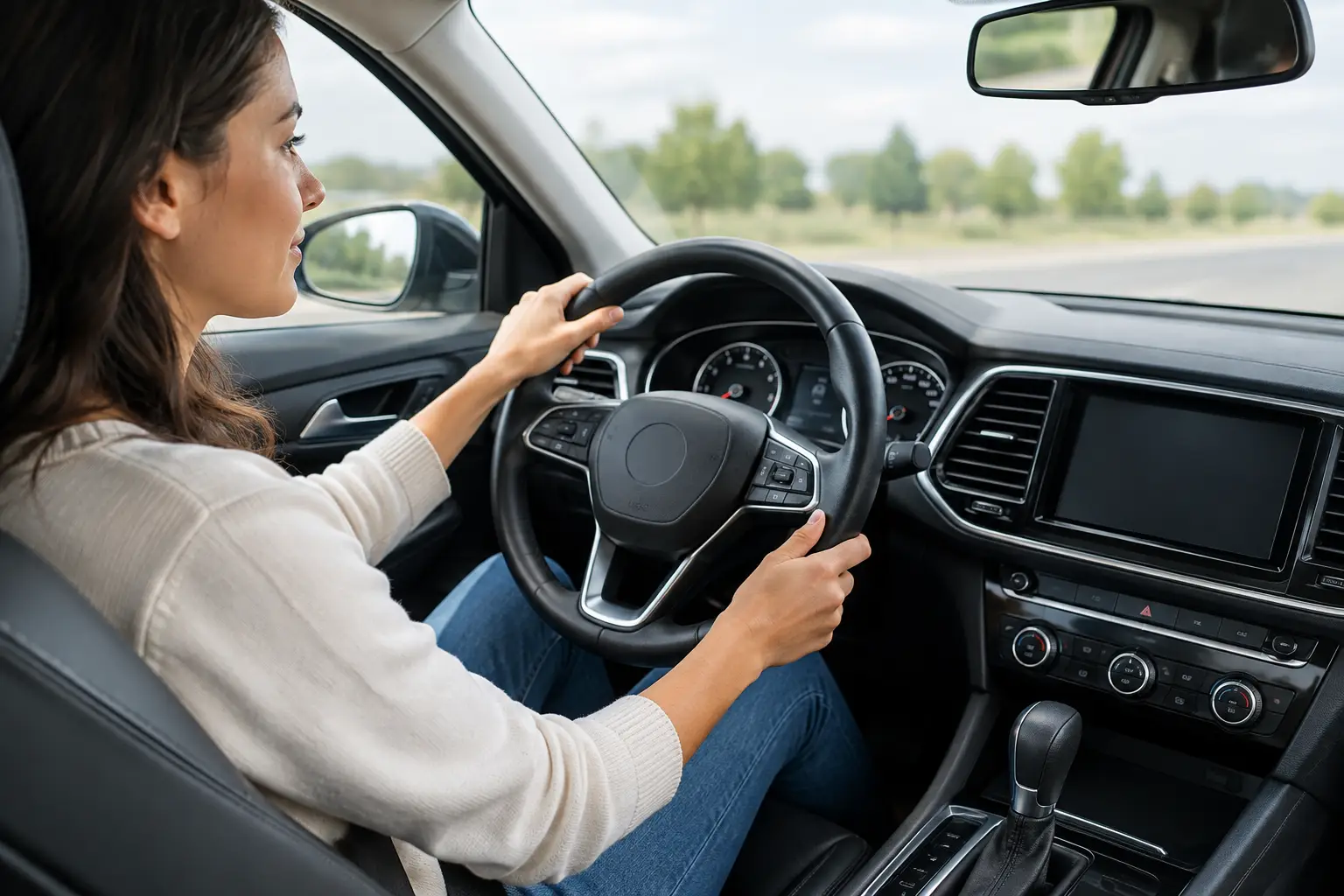
A first driving lesson can feel busy before the car even moves. There are pedals at your feet, switches around the steering wheel, warning lights on the dash, and traffic waiting beyond the windshield. Learning the essential car controls beginners use most often gives you a calmer starting point. You do not need to memorize every button in a vehicle at once. You need to know what controls the car safely, what helps you see, and what to do before pulling away.
Start With a Safe Driving Position
Before you touch the gear selector or press the accelerator, set yourself up to reach the controls comfortably. Adjust the seat so your back rests against the seatback and you can press the brake pedal firmly without stretching your leg straight. Your wrists should be able to rest near the top of the steering wheel while your shoulders remain against the seat.
Set the head restraint behind the middle of your head, not your neck. Then fasten your seat belt before starting the engine. This routine matters because poor seating position affects braking, steering, visibility, and reaction time.
Next, adjust your mirrors. The rearview mirror should show the full rear window, while the side mirrors should show the lanes beside and behind the car with only a small amount of your own vehicle visible. Mirrors are useful information tools, but they do not replace looking over your shoulder before changing lanes or pulling away from a curb.
Essential Car Controls Beginners Use With Their Feet
For most new drivers in California, lessons begin in an automatic-transmission vehicle. An automatic car has two main pedals: the brake on the left and the accelerator on the right. Use your right foot for both. Keep your left foot resting on the floor, away from the pedals.
The Brake Pedal
The brake pedal slows or stops the vehicle. Press it smoothly and progressively rather than stomping on it. A gentle early brake is usually more controlled than a hard, late brake. At a complete stop, keep firm pressure on the brake until it is time to move.
New drivers sometimes look down at the pedals. Avoid this. With practice, your foot should find the brake by feel. Your eyes need to stay up, scanning the road, crosswalks, signs, and other vehicles.
The Accelerator
The accelerator adds speed. It needs much less pressure than many beginners expect. Think of it as rolling your foot forward rather than pushing down. Smooth acceleration makes the ride more comfortable and gives you more time to observe what is happening ahead.
Your speed should match the road, traffic, weather, and posted limit. The speed limit is not a target you must reach. On a crowded South Bay street, near a school, or in a parking lot, a safe speed may be well below the posted maximum.
The Parking Brake
The parking brake keeps a parked car from rolling. Depending on the vehicle, it may be a hand lever, a foot pedal, or an electronic switch. Use it when parking, especially on hills. Before driving away, confirm that it is fully released. A parking-brake warning light on the dashboard can alert you if it is still engaged.
Manual-transmission vehicles add a clutch pedal to the left of the brake. The clutch disconnects the engine from the wheels so you can select gears. Learning manual transmission takes more coordination and patience, but the same core habits apply: sit correctly, look ahead, brake smoothly, and use deliberate inputs.
Steering, Signals, and Gears
The steering wheel controls the vehicle’s direction. Hold it with both hands in a balanced position, commonly around 9 and 3 o’clock. This gives you leverage for turns and helps keep your hands clear of the airbag area. Look where you want the car to go, not at the curb, parked cars, or the obstacle you want to avoid.
For normal turns, use a controlled hand-over-hand or push-pull steering technique, depending on the turn and instructor guidance. After a turn, allow the wheel to return naturally while keeping your hands ready to guide it. Avoid letting the wheel spin freely through your hands.
The turn-signal lever is usually on the left side of the steering column. Signal before turning, changing lanes, leaving a parking space, or pulling to the curb. Signaling early tells others what you intend to do, but it does not give you the right-of-way. You still need to check mirrors, blind spots, pedestrians, bicyclists, and traffic.
The gear selector in an automatic vehicle is usually marked P, R, N, and D. Park locks the transmission for parking, Reverse moves the car backward, Neutral disconnects engine power from the wheels, and Drive is used for normal forward travel. Keep your foot on the brake when selecting a gear. Never shift into Park or Reverse while the vehicle is moving forward.
Lights, Wipers, and Visibility Controls
Seeing clearly and helping others see you are basic safety responsibilities. Headlight controls are commonly found on a stalk near the steering wheel or on the dashboard. Learn the difference between daytime running lights, low-beam headlights, high beams, parking lights, and fog lights if your vehicle has them.
Use low beams from sunset to sunrise and whenever visibility is reduced by rain, fog, smoke, or other conditions. High beams can improve visibility on dark, open roads, but they must be dimmed for oncoming traffic and when following another vehicle. In busy, well-lit areas, low beams are usually the appropriate choice.
Windshield wipers and washers are often controlled from the right-side stalk. Practice finding them while parked. If rain starts, turn on the wipers promptly and slow down. A wet windshield, worn wiper blades, or fogged glass can reduce visibility quickly.
The front and rear defrosters clear condensation from the windshield and rear window. The climate controls may seem unrelated to driving, but they are part of staying alert and seeing properly. Set ventilation, temperature, and defroster settings before you begin moving whenever possible.
Understand the Dashboard Without Staring at It
The instrument panel gives you a quick picture of your car’s condition. The speedometer shows how fast you are traveling. The fuel gauge shows your fuel level. Other common displays include engine temperature, odometer, and gear position.
Warning lights deserve attention, especially the red ones. A red brake warning light, oil-pressure light, overheating warning, or battery warning may mean you should safely pull over and seek help rather than continue driving. A yellow or amber light often signals that the vehicle needs service soon, though the owner’s manual can explain the specific symbol.
Do not try to diagnose a warning light while driving. Keep your focus on the road, find a safe place to stop, and then check the vehicle information or ask for assistance.
A Simple Before-You-Move Routine
A consistent routine helps beginners avoid rushed decisions. Before moving the vehicle, practice this sequence:
- Adjust your seat, head restraint, and mirrors.
- Fasten your seat belt and confirm passengers are secured.
- Start the car with your foot on the brake.
- Check the dashboard for urgent warning lights.
- Select the correct gear, release the parking brake, and scan around the vehicle.
Before entering traffic, add the appropriate signal and complete a final mirror and blind-spot check. This is especially valuable when leaving a curb, backing from a driveway, or pulling out of a parking space.
Avoid Common Beginner Mistakes
The most common control mistakes are usually caused by rushing, not by a lack of ability. Beginners may press the accelerator too firmly, brake too late, forget to cancel a turn signal, or focus on one control while missing what is happening ahead. The answer is not to drive faster to “get used to it.” It is to practice in lower-pressure settings and repeat the same safe routine.
Parking lots, quiet residential streets, and instructor-guided practice sessions are useful places to build control before dealing with heavier traffic. A patient instructor can help you connect each control to a real driving decision, such as slowing before a crosswalk, signaling before a lane change, or using the defroster when the windshield fogs.
South Bay Driving School teaches these skills one step at a time, with lessons paced for teens, adults, returning drivers, and anyone who feels nervous behind the wheel. Confidence grows from repetition, clear feedback, and safe choices, not from being pushed before you are ready.
The controls will soon feel less like a collection of buttons and more like a set of tools you use without panic. Each time you adjust your mirrors, brake smoothly, signal early, and look where you want to go, you are building the habits that make every future drive safer.