
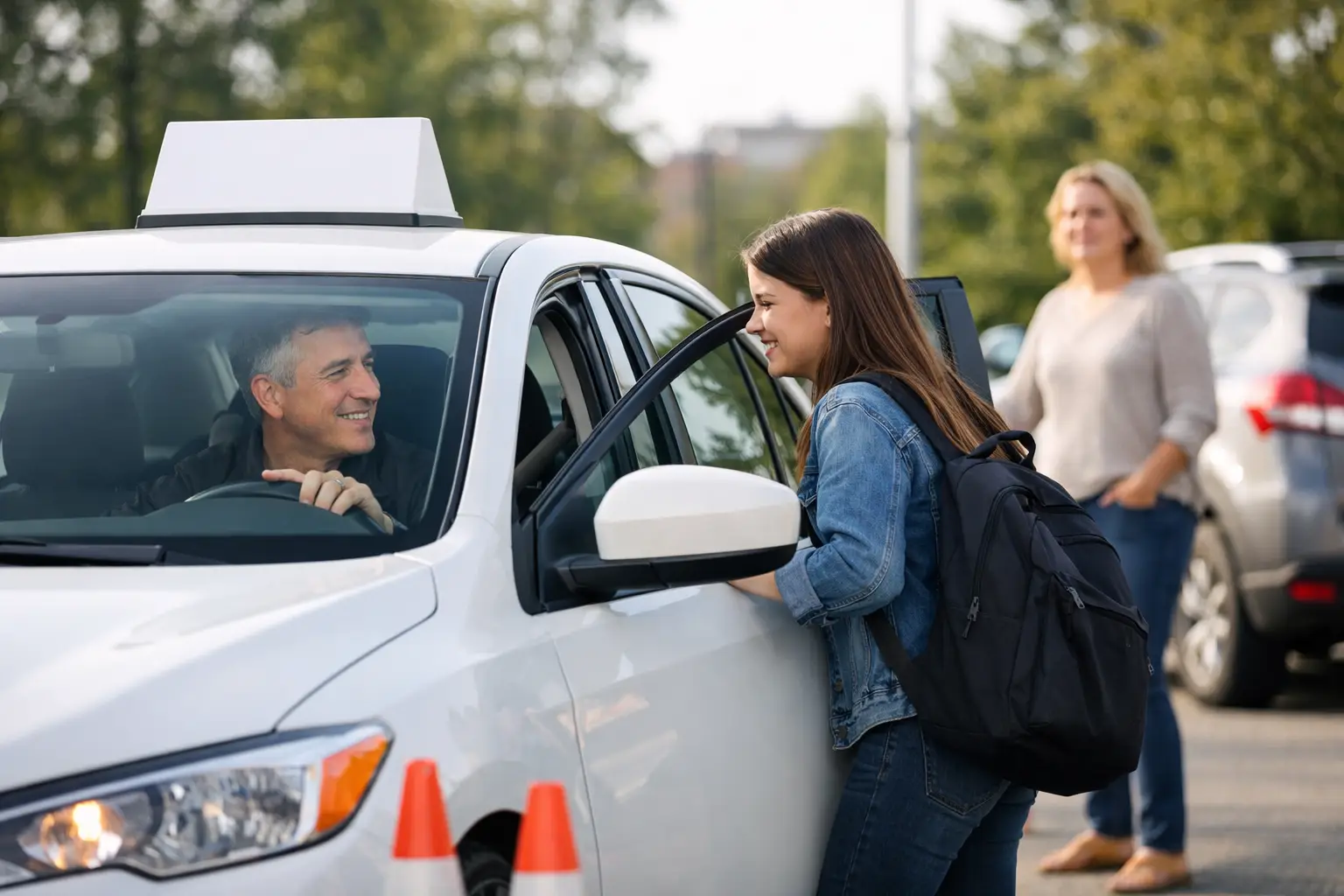
A driving lesson can be difficult to fit into a busy family schedule when a student needs a ride to and from every appointment. Driving school pickup and drop off solves a practical problem for many families, but its real value goes beyond convenience. When it is planned well, pickup service gives a new driver a calmer start to the lesson, more time behind the wheel, and a safe way to transition back to school, home, or another approved location.
For parents, it can mean fewer mid-day schedule changes and less uncertainty about how a teen will get to training. For students, especially those who are nervous or have never driven on public roads, it removes one more barrier to getting consistent practice. The goal is not simply to provide transportation. It is to make professional instruction easier to use at the pace a new driver needs.
What Driving School Pickup and Drop Off Usually Means
Pickup and drop-off service allows an instructor to meet a student at an approved location, conduct the behind-the-wheel lesson in the school vehicle, and return the student to an agreed-upon destination afterward. For many teen students, that may be home or school. Depending on the driving school’s service area, it may also be another appropriate local location arranged in advance.
This is different from a shuttle service. The student is not being transported as a passenger to a separate lesson site. The lesson generally begins when the instructor and student meet, with time set aside for a safety check, a review of the day’s goals, and a gradual start based on the student’s skill level.
The exact arrangements matter. A reliable school should confirm the pickup address, the student’s availability, required permit status, and any location-specific instructions before the appointment. Families should also understand the school’s cancellation policy, service boundaries, and whether travel time affects the available instructional time. These details prevent avoidable confusion on lesson day.
Why Pickup Service Helps New Drivers Learn
A new driver’s first few hours behind the wheel are often shaped by anxiety. A student may be worried about traffic, making mistakes, or disappointing a parent. Starting with a familiar pickup location can lower that pressure. Instead of finding a ride to an unfamiliar office, the student can meet a trained instructor in a setting they already know and focus on the next step: safely operating the vehicle.
Convenience also supports consistency. Driving skills improve through repeated, guided practice, not a single long lesson followed by weeks without driving. When pickup is available near a student’s school or home, it can be easier to schedule regular sessions around classes, sports, work, and family responsibilities.
There is also an educational benefit. Local pickup locations naturally expose students to the roads they use in everyday life. A lesson may begin with residential streets, then move to larger intersections, lane changes, parking lots, or busier commercial areas as the student becomes ready. This gives the instructor a clear view of what the student can manage and where more practice is needed.
In the South Bay, that progression can be especially useful. A student who is comfortable on quiet neighborhood streets may need additional coaching before handling multi-lane traffic, busy school zones, coastal congestion, or the more complex intersections found across Torrance, Redondo Beach, Gardena, Carson, and nearby communities. Familiar roads are helpful, but they should never become a substitute for learning how to make safe decisions in changing conditions.
What Parents Should Confirm Before Booking
Pickup and drop off is most helpful when everyone has the same expectations. Before booking, parents and guardians should ask how the school handles service areas, arrival windows, approved drop-off locations, and communication if an instructor is delayed by traffic or a prior lesson.
It is also wise to confirm what the student must bring. California teen drivers need the appropriate permit before participating in behind-the-wheel instruction, and they should have it with them for every lesson. A student should also wear practical shoes, avoid distractions, and arrive rested enough to focus. Driving while tired, rushed, or overwhelmed makes learning harder.
Parents should let the school know about anything that could affect the lesson. That may include a student’s limited driving experience, anxiety around traffic, vision concerns, a need for extra practice before a DMV road test, or a preferred pace of instruction. A patient instructor can adapt the lesson plan, but only if they understand where the student is starting.
Finally, avoid booking a lesson immediately after an exhausting event or during a very tight scheduling window. A student who needs to be picked up from school and rushed directly to another commitment may not have the mental space to absorb feedback. A little breathing room helps the lesson feel productive rather than pressured.
How a Safe Pickup Lesson Should Start
A professional lesson should not begin with a student pulling into heavy traffic before they have had a chance to settle in. The instructor should take a few minutes to confirm the student’s permit, adjust the seat and mirrors, review vehicle controls, and discuss the route or skill focus for the appointment.
For a first-time driver, the early portion may cover basic vehicle control: smooth braking, steering, turns, scanning, and proper lane position. A more experienced student might spend the lesson on lane changes, unprotected turns, freeway entry, parking, or DMV-style maneuvers. The pickup location is simply the starting point. The route should be chosen for the student’s current ability, not for the instructor’s convenience.
The school vehicle should also support learning safely. Dual-control braking gives the instructor an additional safeguard when teaching beginners, particularly during the first lessons when reaction time and traffic awareness are still developing. Students need room to make small, correctable mistakes while receiving calm, immediate coaching.
Pickup Service Is Not the Right Fit for Every Lesson
Convenience has limits, and a good driving school will be straightforward about them. Some pickup addresses may fall outside the service area. Others may be difficult or unsafe for a lesson pickup because of restricted access, severe congestion, limited stopping space, or school dismissal traffic. In those cases, meeting at a nearby approved location may be the better choice.
A student preparing for a DMV drive test may also need a more specific plan. Test preparation often works best when the lesson is scheduled around the DMV location, appointment time, and the exact skills the student needs to refine. Pickup may still be available, but it should be coordinated early so there is enough time for practice without creating last-minute stress.
Adult beginners, returning drivers, and senior drivers may have different preferences. Some appreciate home pickup because it reduces the pressure of arranging transportation. Others prefer meeting near a quiet practice area where they can begin in a lower-traffic environment. The best option depends on comfort level, goals, and the type of driving being practiced.
Making Pickup and Drop Off Work Smoothly
The simplest way to get value from pickup service is to treat it as part of the lesson plan, not an extra detail. Keep the phone number on file current, provide clear gate or apartment instructions when needed, and make sure the student is ready a few minutes before the scheduled arrival. If the pickup location changes, notify the school as early as possible.
Students should use the time after drop-off well, too. A quick conversation with a parent about what they practiced can reinforce the lesson. Instead of asking only whether they drove well, ask what felt easier, what still felt challenging, and what the instructor wants them to practice next. That kind of support helps a teen see driving as a skill built over time, not a test they must pass immediately.
South Bay Driving School has served local learners since 1992, and the strongest results still come from the same approach: regular practice, patient instruction, clear feedback, and a schedule families can realistically maintain.
A convenient pickup can get a student into the driver’s seat. What builds lasting confidence is using that time to practice carefully, ask questions, and make safer choices one trip at a time.