
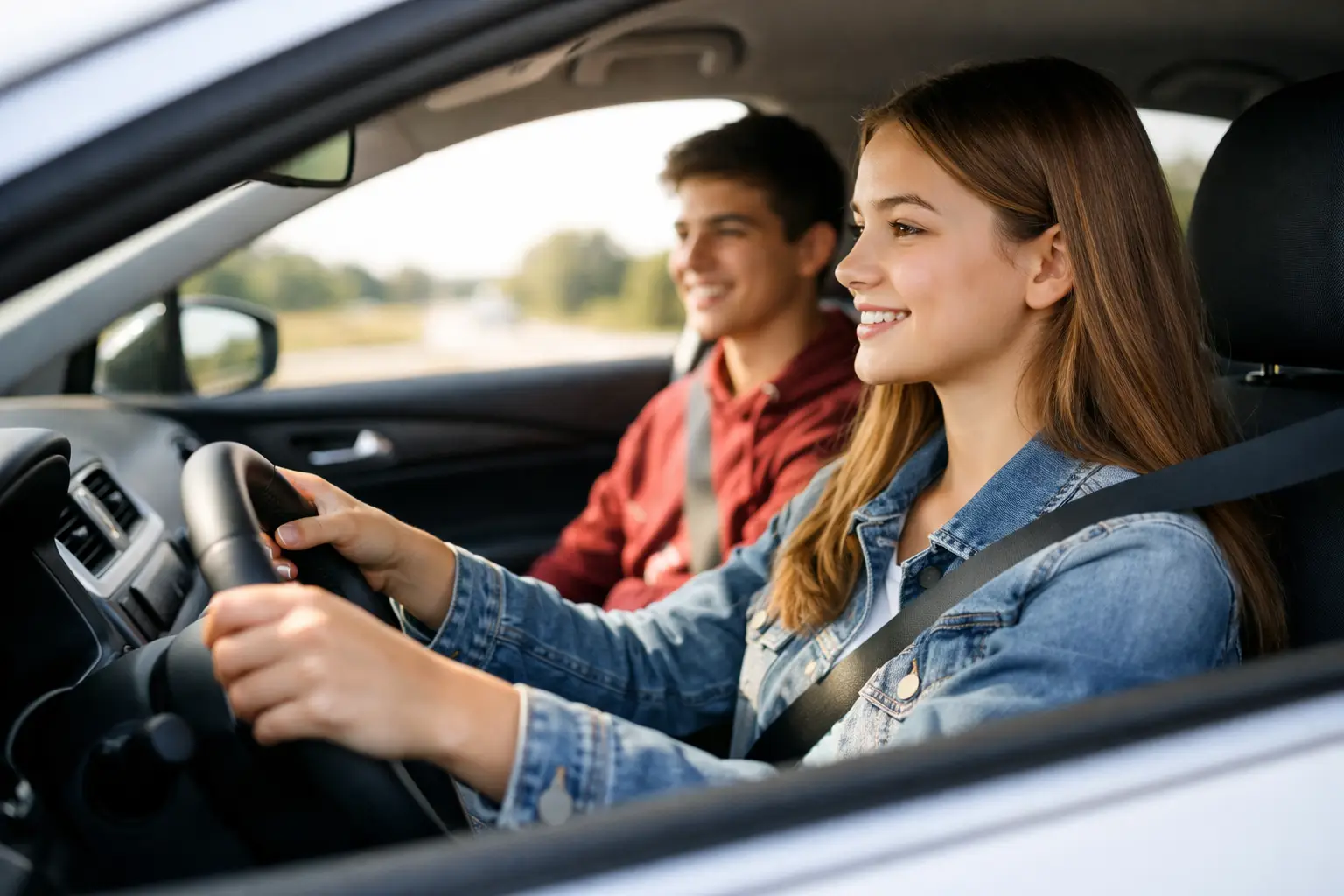
The first few seconds after a traffic light turns green can reveal a lot about a new driver. A teen who checks left, right, and ahead before moving is practicing one of the best driving habits for teens: staying actively aware instead of simply reacting. That habit matters on busy South Bay streets, in school-zone traffic, and at every intersection where another driver may make an unexpected move.
Safe driving is not one skill learned in a single lesson. It is a set of repeatable decisions that become more natural with guided practice. For teens working toward a California license, the goal is bigger than passing the DMV drive test. It is learning how to make calm, responsible choices when traffic, weather, passengers, or pressure make driving harder.
1. Scan Far Ahead, Not Just at the Car in Front
New drivers often focus closely on the bumper directly ahead of them. That can make them late to notice a slowing line of traffic, a pedestrian at a crosswalk, or a vehicle turning across their path. Encourage teens to look well ahead down the road while continuing to check the area immediately around the vehicle.
A good scanning routine includes looking ahead, checking mirrors regularly, and noticing side streets, parked cars, cyclists, and crosswalks. In neighborhoods with narrow streets and frequent curbside parking, a driver should also watch for doors opening and people stepping out from between vehicles.
This habit gives a teen more time to respond gently. Instead of braking suddenly, they can ease off the accelerator early and maintain a safer following distance.
2. Leave Space That Gives You Options
Following too closely is one of the quickest ways for an inexperienced driver to lose their safety margin. Traffic can stop without much warning, especially near freeway entrances, shopping areas, and busy intersections. A teen needs enough room to see what is happening ahead and enough time to brake smoothly.
The right amount of space depends on conditions. A normal dry day calls for a reasonable following distance, but rain, darkness, heavy traffic, or a larger vehicle ahead all call for more room. If another driver cuts into that space, the safest response is usually to ease back and rebuild it, not to speed up or take it personally.
Space is not only about the vehicle in front. Teens should avoid driving beside another car for long periods when possible, especially near freeway traffic. Keeping an open path around the vehicle provides more choices if another driver changes lanes suddenly.
3. Make Every Intersection a Fresh Decision
Intersections deserve extra attention because several paths cross at once. A green light does not guarantee that the intersection is clear. Before proceeding, teens should look for red-light runners, late left turns, pedestrians, bicycles, and vehicles entering from side streets.
At a stop sign, the complete stop should happen before the limit line, crosswalk, or intersection. Then the driver should look carefully in all directions and yield as needed. Rolling through a stop may feel small, but it removes the time needed to see a child, pedestrian, or approaching car.
Left turns require patience, too. A teen should wait for a safe gap rather than assume an oncoming driver will slow down, turn, or stop. If the view is blocked by a large vehicle, creeping forward carefully may be necessary, but guessing is never a good substitute for visibility.
4. Put the Phone Away Before the Car Moves
The safest text to answer while driving is the one that waits. For teen drivers, phones create a serious distraction because they pull attention away from the road, hands away from the wheel, and focus away from decisions that can change in seconds.
Before starting the car, set navigation, choose music, silence notifications, and place the phone where it cannot become a temptation. If directions need to change or a call truly cannot wait, pull into a safe, legal place first.
This also applies to passengers. Friends can be a major distraction even when no phone is involved. California’s provisional license rules limit who new teen drivers may carry, but good judgment should go beyond the legal minimum. A teen who feels distracted, rushed, or pressured to show off should reduce the distraction or choose not to drive until they can focus.
5. Use a Consistent Mirror and Blind-Spot Routine
Mirrors provide useful information, but they do not show everything. Before changing lanes, merging, pulling away from the curb, or moving around a cyclist, teens need a routine that includes mirror checks, a turn signal, and a quick look over the shoulder when appropriate.
The order matters. Signaling early communicates the driver’s plan. Checking mirrors shows nearby traffic. Looking over the shoulder helps confirm that a vehicle, motorcycle, bicycle, or pedestrian is not hidden in a blind spot. Then the driver should make a smooth move only when the space is clearly safe.
A rushed lane change can create problems quickly on Los Angeles-area freeways. Missing an exit is inconvenient. Forcing a last-second merge is dangerous. Teens should learn that continuing safely and rerouting is always the better choice.
6. Brake and Accelerate Smoothly
Smooth driving is safer driving. Hard acceleration, abrupt braking, and sharp steering make it harder for a teen to stay in control and harder for other road users to predict what the vehicle will do.
Teens can build smoothness by looking ahead and planning early. If a red light is visible in the distance, easing off the gas gives the car time to slow naturally. If a turn is coming, slowing before the turn rather than in the middle of it helps maintain control.
This habit also makes passengers more comfortable and helps a teen notice whether they are driving too fast for the conditions. The posted speed limit is not always the safest speed. Curves, wet roads, glare from the sun, and limited visibility may require slower driving.
7. Treat Speed Limits as a Starting Point, Not a Challenge
Speed limits set the maximum legal speed for ideal conditions. They do not promise that every driver should travel at that speed every moment. In a crowded parking lot, near a school, through a residential area, or during rain, a safe driver adjusts.
Teens should also resist the urge to match an aggressive driver’s pace. Tailgating, speeding, or weaving traffic may feel pressuring, but a new driver does not need to respond to another person’s poor choices. Stay predictable, keep a safe pace, and let impatient drivers pass when it is safe to do so.
8. Practice Parking Until It Feels Routine
Parking is often where new drivers feel the most exposed. They may worry about holding up traffic, misjudging distance, or needing to correct their position. The answer is not to rush. It is to practice the same steps in low-pressure settings until they are familiar.
Work on pulling into and backing out of spaces, parallel parking, curbside parking, and parking on hills. When backing, move slowly and check all around the vehicle. Backup cameras are helpful, but they do not replace looking through rear and side windows or checking for people walking behind the car.
A patient instructor can help teens break parking into manageable parts: vehicle position, steering timing, speed control, and final adjustment. Small corrections are normal. What matters is making them safely.
9. Know When Conditions Call for Extra Caution
A teen may feel confident on a clear afternoon and still need to slow down significantly in rain or darkness. Wet pavement reduces traction, headlights limit what can be seen, and glare can hide lane markings, pedestrians, or standing water.
Before driving in unfamiliar conditions, teens should know how to use headlights, windshield wipers, defrosters, and hazard lights appropriately. They should also understand that cruise control is not a good choice on wet roads. If weather becomes severe or visibility is poor, delaying the trip may be the smartest decision.
10. Review Drives Without Turning Mistakes Into Shame
The best driving habits for teens grow faster when each drive includes a short, calm review. Parents can ask what felt comfortable, what was difficult, and what the teen would do differently next time. One specific observation is more useful than a long lecture after a mistake.
Professional behind-the-wheel instruction can add structure to that practice. At South Bay Driving School, lessons are paced to help new drivers build vehicle control, traffic awareness, parking skills, and DMV test readiness without adding unnecessary pressure. Repetition with clear feedback helps turn a nervous beginner into a more prepared driver.
A teen does not need to drive perfectly to drive responsibly. They need to stay attentive, leave themselves time and space, and keep choosing safety when the road becomes unpredictable. Those decisions, practiced one trip at a time, are what carry a new driver well beyond the day they receive a license.