
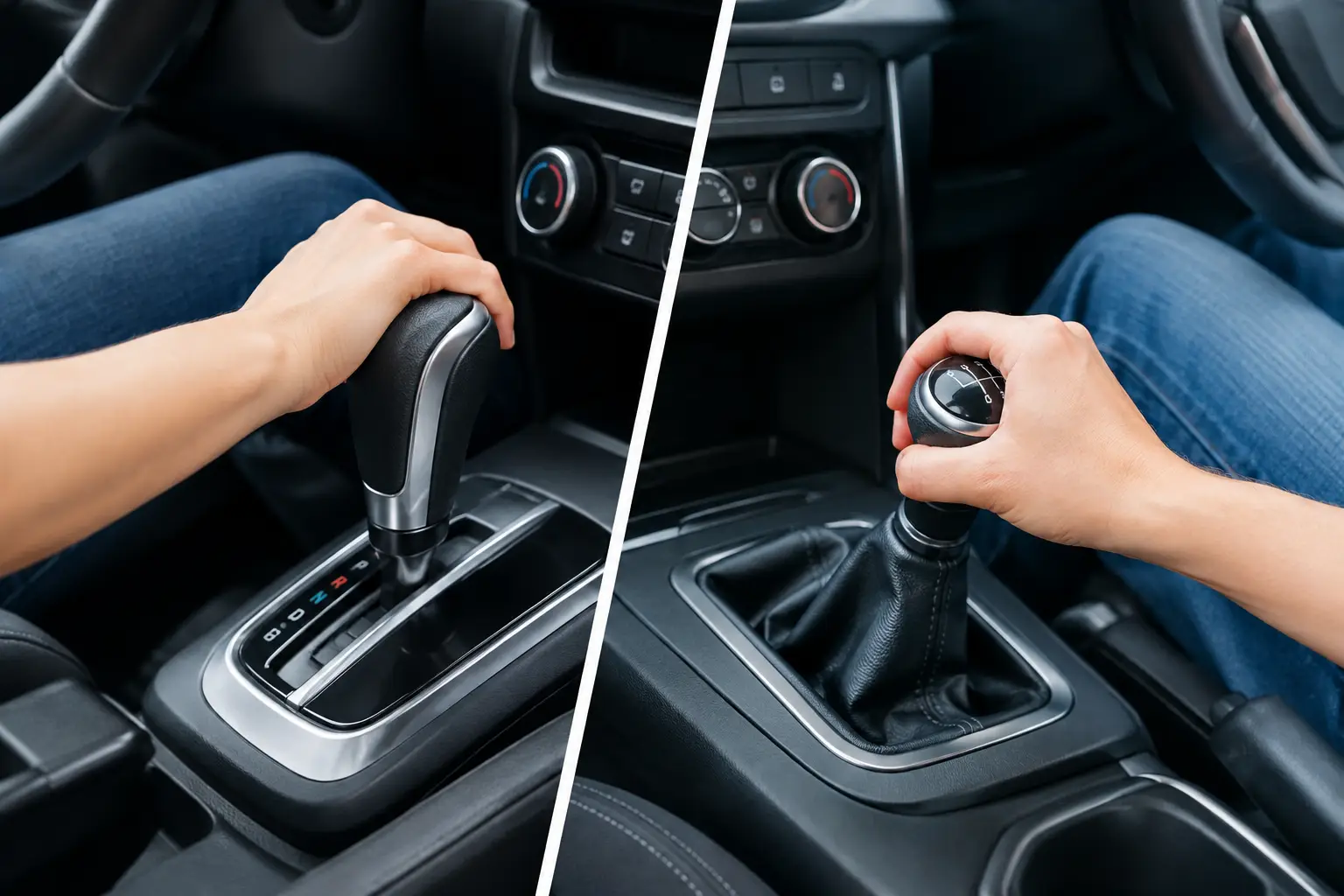
A first driving lesson should build confidence, not add an unnecessary obstacle. When families compare automatic versus manual driving lessons, the best choice usually comes down to the vehicle a new driver will use most often, how quickly they need to prepare for the DMV test, and whether learning a manual transmission serves a real long-term goal.
Both options can produce safe, capable drivers. The difference is where a student’s early attention goes. Automatic lessons allow more mental energy for traffic awareness, steering control, braking, lane position, and decision-making. Manual lessons add clutch control and gear selection, which can be rewarding but require more practice before those actions feel natural.
Automatic versus manual driving lessons: the main difference
An automatic vehicle shifts gears on its own. The driver uses the accelerator and brake, keeps both hands available for steering, and can focus on reading the road. For most first-time teen drivers and adult beginners, this is the most direct path to building reliable driving habits.
A manual vehicle requires the driver to coordinate the clutch pedal, gear shifter, accelerator, and brake. Early lessons often include finding the clutch engagement point, starting smoothly, shifting up and down, and stopping without stalling. Those are valuable skills, but they increase the number of decisions a beginner must make at low speeds and in traffic.
Neither choice is a measure of intelligence or driving ability. A nervous student may thrive in an automatic because the car feels more manageable. Another student may enjoy the hands-on challenge of a stick shift and be willing to put in extra practice. The right lesson plan meets the student where they are and gives them a safe pace for progressing.
Why automatic lessons work well for most new drivers
For many South Bay families, the practical answer is automatic instruction. Most household vehicles and rental cars in the United States have automatic transmissions. A teen who will drive a family SUV, sedan, or electric vehicle after licensing generally benefits most from learning the vehicle controls they will actually use every day.
Automatic lessons also make it easier to introduce real driving environments sooner. Instead of concentrating on whether the car will stall at a stop sign, a new driver can practice scanning intersections, checking mirrors, judging gaps in traffic, maintaining a safe following distance, and managing turns. These are the skills that protect drivers, passengers, cyclists, and pedestrians.
This can be especially helpful for students preparing for the California DMV road test. A road test is not about showing off complicated vehicle mechanics. It is about demonstrating safe control, observation, lawful decisions, and calm responses to changing conditions. Starting in an automatic lets many students develop those habits efficiently.
Automatic instruction may also be the better fit for returning adult drivers or seniors who have not driven in years. The goal is often renewed independence and confident everyday mobility, not adding a new mechanical skill. Patient instruction in an automatic can help the student rebuild comfort step by step.
When manual driving lessons make sense
Manual driving lessons are worth considering when a student has a clear reason to learn. Perhaps they own or expect to drive a manual vehicle, have access to a family car with a stick shift, enjoy performance or classic cars, or simply want the skill for personal interest. Learning manual transmission can also help a driver better understand how a vehicle responds to engine speed, gearing, and hills.
The experience demands patience. Stalling during the first few sessions is normal, particularly when starting uphill or moving through stop-and-go traffic. A supportive instructor will teach the skill in manageable stages, often beginning in low-pressure areas before moving into more complex streets and traffic situations.
Manual students should plan for additional practice time. The objective is not merely to shift gears, but to shift without taking attention away from the road. A driver is ready to use a manual car independently when clutch control, braking, steering, mirror checks, and traffic observation work together consistently.
For students in Torrance and nearby communities, manual lessons can be particularly useful when they want focused coaching rather than trying to learn from a friend or family member in a stressful parking lot. Professional instruction gives the student a structured place to make mistakes, correct them, and repeat the skill safely.
Will an automatic affect a California driver’s license?
For a standard California noncommercial Class C driver’s license, taking the road test in an automatic vehicle generally does not prevent a driver from operating a manual passenger vehicle later. That makes automatic training a practical option even for students who may choose to learn stick shift in the future.
However, licensing rules can differ for commercial licenses and certain specialized vehicle classes. Students with commercial driving goals should confirm the current DMV requirements for the license they need before choosing a training path.
Even when a legal restriction is not a concern, experience still matters. A license gives permission to drive, but it does not replace practice. A driver who has only used an automatic should take manual lessons before operating a stick shift alone, especially in Los Angeles traffic, on hills, or in an unfamiliar vehicle.
Choose based on your real driving life
Parents often ask which option is “better.” The more useful question is: Which one helps this student become a safe, confident driver in the vehicle they are most likely to drive?
Choose automatic lessons if the student is a complete beginner, feels anxious behind the wheel, needs to prepare efficiently for a DMV test, or will primarily use an automatic family vehicle. This choice keeps the early focus on defensive driving habits and road awareness.
Choose manual lessons if the student has reliable access to a stick-shift vehicle, needs the skill for a specific vehicle or goal, and is prepared to spend more time practicing. Manual instruction is not inherently harder in the long run, but its first stages require more coordination and repetition.
There is also a middle path. A student can begin in an automatic, establish strong traffic skills and confidence, then schedule manual-transmission lessons later. For many drivers, that sequence feels less overwhelming. They already understand intersections, lane changes, parking, and safe braking, so they can devote more attention to clutch and gear control.
What good instruction should include in either vehicle
Transmission choice matters, but the quality and pacing of instruction matter more. Every lesson should build beyond basic vehicle movement. A student needs repeated coaching on observation, speed management, right-of-way decisions, turns, lane changes, parking, freeway readiness when appropriate, and responding calmly to other road users.
A good instructor adjusts the lesson to the student rather than rushing through a fixed routine. One student may need extra time with smooth stops and turns. Another may be ready to practice busy intersections but need reminders to scan for pedestrians. Progress is strongest when the student understands not only what to do, but why a safe choice matters.
Parents can support the process by keeping practice calm and specific. After a lesson, ask what the student worked on and what they want to repeat next time. Avoid turning every drive into a critique. A clear reminder about mirror checks or gradual braking is more useful than a stream of corrections.
Let confidence guide the next step
The best transmission is the one that supports safe, repeatable driving now while leaving room for future goals. Automatic lessons are often the practical starting point for new California drivers. Manual lessons offer an additional skill for drivers who need or genuinely want it.
South Bay Driving School approaches both paths with patient, personalized instruction because confident driving is built through practice, not pressure. Start with the vehicle that fits your daily needs, learn the fundamentals thoroughly, and add new skills when you are ready.