
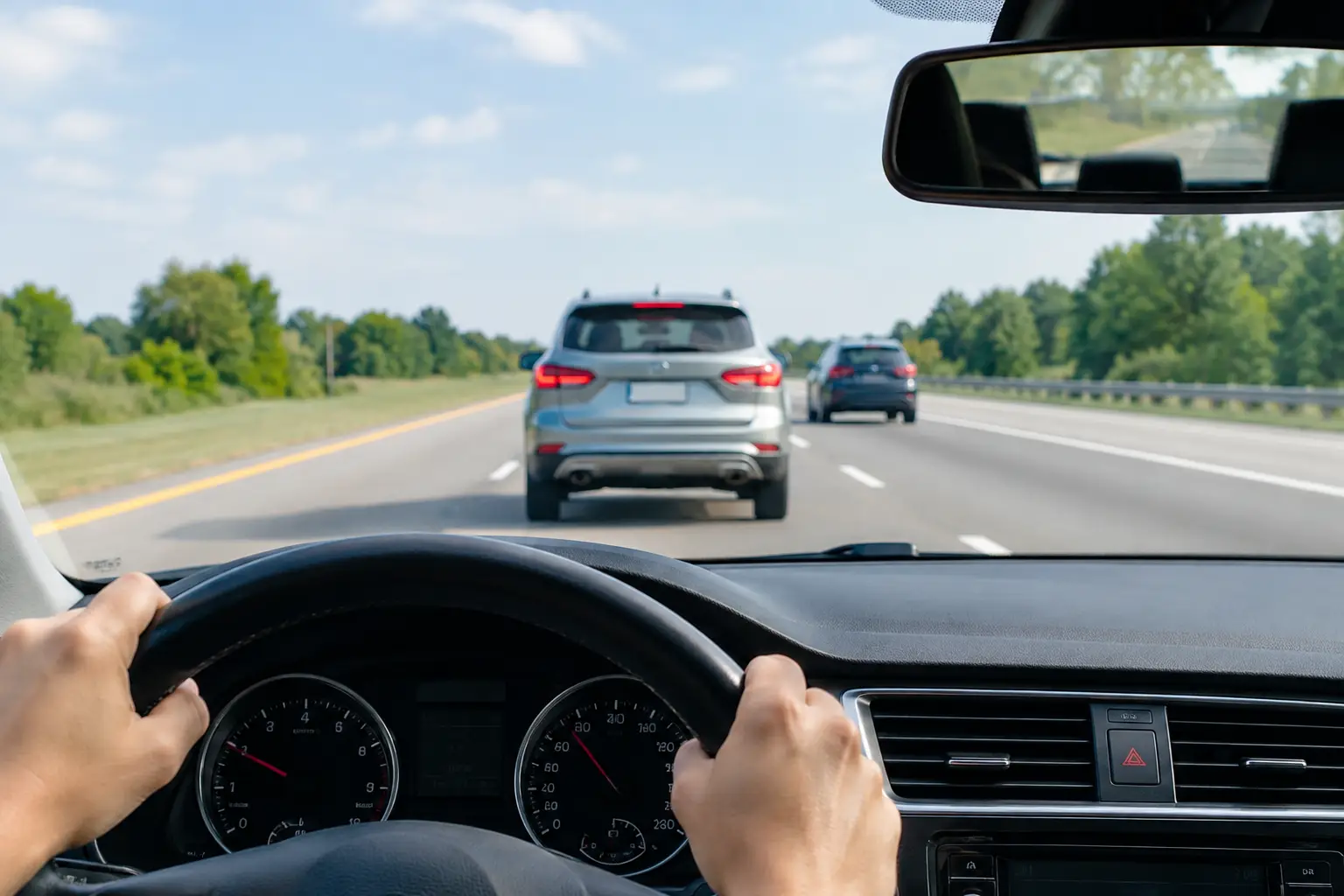
A driver ahead brakes suddenly near a busy Torrance intersection. The space between your car and theirs disappears faster than you expect, especially if you were watching the brake lights instead of looking well ahead. Learning how to judge following distance gives you time to notice, react, and stop smoothly rather than making a last-second decision.
Following distance is not just something to remember for a DMV drive test. It is one of the everyday habits that protects you, your passengers, cyclists, pedestrians, and the drivers around you. For new drivers, it also reduces a common source of anxiety: feeling rushed by traffic or unsure how much room is enough.
How to Judge Following Distance With the Three-Second Rule
The most practical starting point is the three-second rule. Choose a fixed object ahead, such as a sign, light pole, road marking, or shadow. When the rear of the vehicle in front of you passes that object, begin counting: “one one-thousand, two one-thousand, three one-thousand.”
If your vehicle reaches the same object before you finish counting to three, you are following too closely. Ease off the accelerator and create more room. You do not need to brake hard or make an abrupt correction. A gentle reduction in speed is usually enough to rebuild a safe gap.
The three-second rule works because it adjusts naturally with speed. At higher speeds, you travel farther during three seconds. At lower speeds, you travel less distance. Trying to judge following distance by car lengths can be harder because vehicle sizes vary and speed changes constantly.
A three-second gap is a good minimum in favorable conditions. It gives you time to see a problem, move your foot from the accelerator to the brake, and begin responding. But it is a starting point, not a guarantee. Real driving conditions often call for more space.
When You Need More Than Three Seconds
Safe following distance depends on traction, visibility, traffic flow, and the vehicles around you. The road may be dry, but that does not automatically mean three seconds is enough.
Add extra time when roads are wet. Rain can make pavement slippery, especially during the first part of a storm when oil and dust rise to the surface. In South Bay traffic, a light rain after a long dry stretch can be more hazardous than it looks. Increase your gap to at least four seconds, and leave even more room if standing water, poor visibility, or heavy traffic is involved.
Increase your following distance at night as well. You may not see a hazard as early as you would during the day. Headlights, glare, and dark clothing can make it harder to judge what is happening ahead. If you cannot clearly see the road beyond the vehicle in front of you, give yourself additional room.
Large vehicles deserve extra space. A truck, bus, van, or SUV can block your view of traffic ahead. If you follow too closely, you lose the ability to anticipate slowing traffic, lane closures, or pedestrians near a crosswalk. Staying farther back lets you see around the vehicle when possible and gives you more time if it stops unexpectedly.
You should also create a larger gap when someone is tailgating you. Do not respond by speeding up or braking suddenly to “teach them a lesson.” Instead, gradually increase the distance in front of your vehicle. That gives you more room to brake gently if traffic slows, reducing the chance that the driver behind you will hit you. When it is safe, move right or allow the tailgating driver to pass.
Watch the Traffic Ahead, Not Just Brake Lights
Many following-distance mistakes begin with narrow focus. New drivers often stare at the back of the nearest vehicle because it feels like the immediate threat. The better habit is to look through and beyond that vehicle whenever you can.
Scan several cars ahead. Notice when brake lights begin appearing in the distance, traffic signals are changing, or vehicles are bunching up near freeway entrances and exits. This early information helps you release the accelerator before the driver in front of you brakes. Smooth drivers are not simply quick to react. They are prepared because they are looking ahead.
This approach is especially useful on crowded roads such as Pacific Coast Highway, Hawthorne Boulevard, or freeway approaches where traffic can change speed without much warning. A proper following gap gives you the physical space to use what your eyes are seeing.
Avoid Common Following-Distance Mistakes
The most common mistake is treating the gap as an invitation for another car to merge. It can be frustrating when another driver enters the space you created, particularly during slow freeway traffic. Still, the safe response is to let off the accelerator and restore your gap. Protecting your space is less important than protecting your stopping distance.
Another mistake is matching the speed of the vehicle ahead too closely. If that driver speeds up, you speed up. If they brake, you brake. This can turn your drive into a series of abrupt changes. Instead, maintain a cushion and aim for smooth, predictable adjustments.
Drivers also tend to underestimate distance when they are late, distracted, or emotionally upset. Tailgating can feel like a way to move faster, but it rarely saves meaningful time. It does increase the chance of a rear-end collision, which is often one of the most preventable types of crash.
Finally, do not assume anti-lock brakes, automatic emergency braking, or other vehicle safety features replace your judgment. These systems can help in certain situations, but they have limits. Weather, tire condition, road surface, and reaction time still matter. The driver remains responsible for leaving enough room.
How Following Distance Helps on the DMV Drive Test
During a California DMV drive test, an examiner may not ask you to say “three-second rule” out loud. They will, however, observe whether you make safe spacing decisions. Following too closely can make your braking look late, your turns feel rushed, and your overall driving appear less controlled.
A good gap supports several test skills at once. It gives you time to check mirrors before slowing, stop smoothly behind vehicles at traffic lights, and respond calmly when traffic changes. It also demonstrates that you are aware of conditions beyond the hood of your car.
At a red light, leave enough room that you can see the rear tires of the vehicle ahead touching the pavement. This is not the same as the three-second rule for moving traffic, but it is a useful stopping-position habit. It gives you space to move around the vehicle if necessary and helps prevent a minor bump if you are hit from behind.
Practice Building the Habit
Following distance becomes easier when you practice it deliberately. On a calm drive, choose a fixed object and count your three seconds several times. Check your gap after turns, lane changes, and traffic-light stops. Soon, the spacing will begin to feel natural rather than something you have to calculate.
If you are learning with a parent or instructor, ask for feedback on whether your gap is changing appropriately with speed and conditions. A patient driving lesson can be especially helpful for drivers who know the rule but struggle to apply it while steering, checking mirrors, watching signs, and managing traffic at the same time.
The goal is not to keep one exact distance all day. The goal is to give yourself enough time and room to make safe choices. When you can see farther ahead, keep a calm cushion, and adjust before a situation becomes urgent, you are building the kind of confidence that lasts well beyond the road test.