
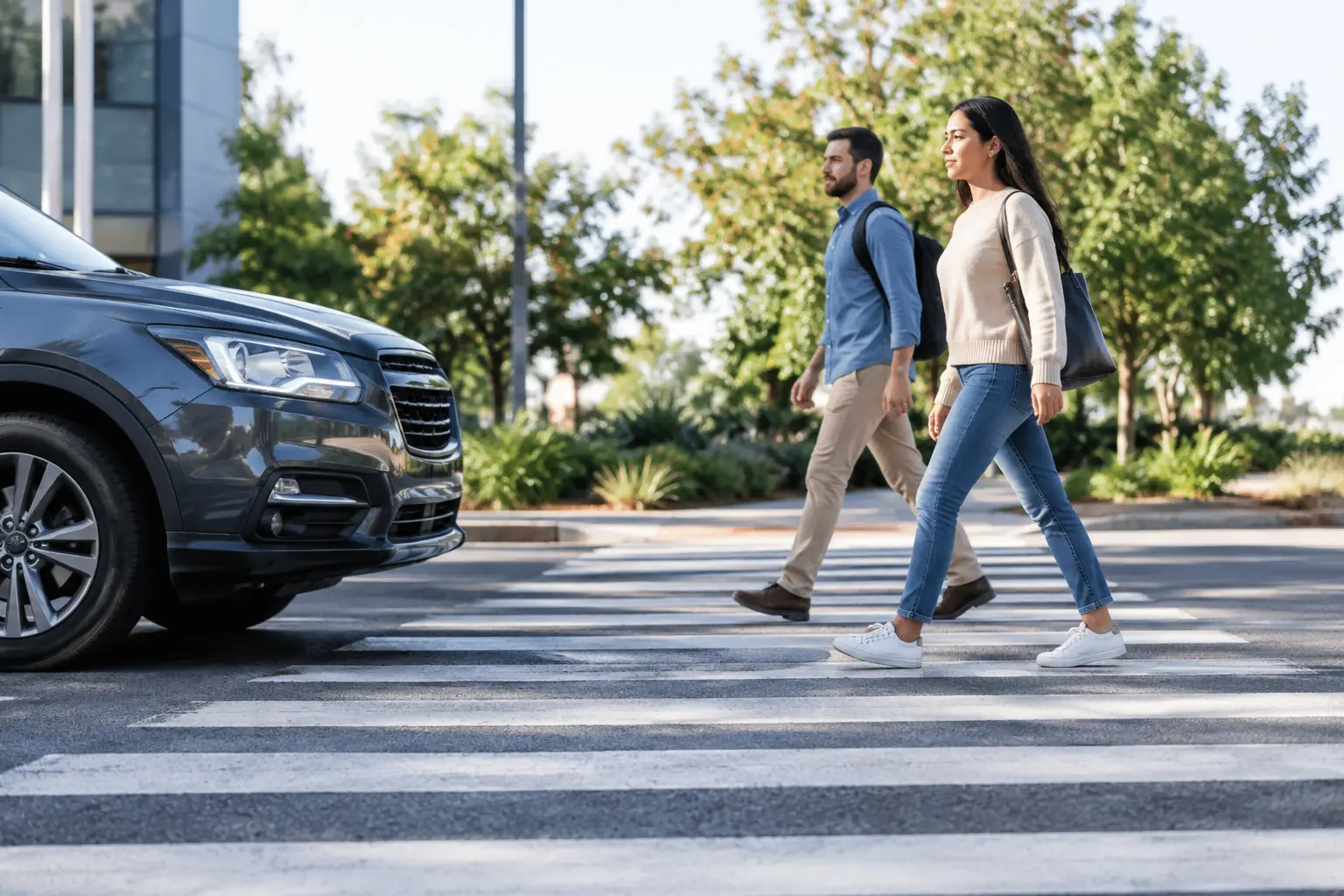
A crosswalk can turn an ordinary drive into a high-stakes decision in seconds. Learning how to yield at crosswalks is not just about avoiding a DMV test mistake or a traffic ticket. It is about recognizing that a person walking, using a wheelchair, pushing a stroller, or riding a scooter is far less protected than anyone inside a vehicle.
For new drivers, the best habit is simple: scan early, slow early, and be prepared to stop. In busy South Bay neighborhoods, a pedestrian may be stepping out from between parked cars, crossing near a school, or waiting at a corner while you prepare to turn. Giving yourself time to see the full situation makes yielding calmer and safer.
What yielding at a crosswalk really means
Yielding means allowing a pedestrian to go first when they have the right-of-way or when proceeding would create a risk. It does not always mean stopping the instant you see someone near a corner. It means reducing speed, evaluating their position and direction, and stopping when necessary so they can cross safely.
In California, drivers must yield to pedestrians who are crossing the roadway within a marked or unmarked crosswalk at an intersection. A marked crosswalk has painted lines. An unmarked crosswalk generally exists at an intersection where sidewalks would naturally continue across the street, even if no white lines are painted on the road.
That second point surprises many new drivers. Do not assume there is no crosswalk simply because there are no stripes. At an intersection, look for corners, curb ramps, pedestrian signals, and people waiting to cross.
Pedestrians also have responsibilities. They should not suddenly leave a curb and move into the path of a vehicle that is so close it cannot safely stop. Still, drivers must use due care. If there is any uncertainty, choose the safer response: slow down and be ready to stop.
How to yield at crosswalks step by step
The process starts well before your car reaches the painted lines. As you approach an intersection or a mid-block crosswalk, check both sidewalks, the corners, and the roadway ahead. Look beyond the vehicle directly in front of you. A pedestrian may be hidden from view until the last moment.
Ease off the accelerator when you see someone approaching a crosswalk, standing at the curb, or already crossing. Cover the brake when conditions call for it. This gives you a smoother stop than waiting until you are close to the crosswalk and braking hard.
If a pedestrian has entered your lane, stop and let them continue. Stop behind the crosswalk line when one is present. Pulling into the crosswalk blocks the path people need to use, particularly people using wheelchairs, canes, walkers, or strollers.
Do not start moving again just because the pedestrian has passed in front of your hood. Make sure they have cleared the lane you will enter, and check for a second person crossing behind them. Children, dogs, and groups of pedestrians are easy to miss when your attention narrows to one person.
When you do proceed, accelerate gently and keep scanning. Crosswalk safety is not finished when the first pedestrian reaches the curb.
Yielding while making a turn
Turning drivers often create the greatest crosswalk risk because their attention is divided. Before a right or left turn, many drivers focus so intensely on traffic that they forget to check the crosswalk.
At a green light, you may turn only after yielding to pedestrians lawfully crossing the street you plan to enter. On a permitted left turn, yield to oncoming traffic and pedestrians before completing the turn. Do not edge into the crosswalk to get a better view if people need that space.
A right turn on red requires extra patience. First, make a complete stop at the limit line, crosswalk, or intersection. Then check for pedestrians before looking for a safe opening in traffic. A gap in vehicle traffic does not make the turn safe if someone is crossing in front of you.
Avoid waving a pedestrian through when you are stopped but other traffic may not be. Your intention may be kind, but your gesture can be misunderstood. The safer approach is to remain stopped, make your vehicle’s position predictable, and let the pedestrian decide when it is safe to cross.
Marked, unmarked, and mid-block crossings
A marked crosswalk is the most recognizable type, but it is not the only place where drivers need to yield. At intersections, treat the natural continuation of the sidewalk as a possible crossing area, especially where people are waiting at opposite corners.
Mid-block crosswalks deserve special attention because pedestrians may appear outside the usual intersection pattern. Warning signs, flashing beacons, school-area markings, and painted lines are all signals to reduce speed and search carefully. Some crossings use rectangular rapid-flashing beacons or other pedestrian-activated signals. When they are activated, assume someone may be entering the roadway even if you cannot immediately see them.
Never pass a vehicle that has stopped at a crosswalk. The stopped driver may be yielding to a person you cannot see. Passing them can place you directly in a pedestrian’s path with almost no time to react.
School zones and people who may need more time
Children can be unpredictable near schools, parks, and residential streets. They may run toward a friend, drop something in the road, or cross without accurately judging vehicle speed. Follow posted school-zone speed limits, watch for crossing guards, and expect movement near buses and parked vehicles.
A crossing guard is there to create a safer gap for students. Follow the guard’s directions and remain stopped until the crossing is clear. Do not drive around a guard or another stopped vehicle to save a few seconds.
Also allow extra time for seniors, people with disabilities, and anyone who appears to be moving slowly. The legal right-of-way question matters, but the practical safety decision is often more straightforward: wait. A few additional seconds is never worth putting someone at risk.
Common crosswalk mistakes to avoid
The most common mistake is looking only in the direction of vehicle traffic. Before every turn, make a deliberate pedestrian check toward the crosswalk. This is a useful habit for DMV road-test preparation as well as everyday driving.
Another mistake is stopping too late or too far into the crossing. Practice recognizing crosswalk signs and curb activity early so your braking is gradual and your vehicle remains behind the limit line. Smooth, early braking tells drivers behind you what you are doing and reduces the chance of a rear-end collision.
Drivers also make mistakes when traffic is heavy. If a pedestrian is crossing multiple lanes, do not assume another driver will stop. Watch the person’s path, the lanes beside you, and vehicles approaching from behind. On multi-lane roads, keep yielding until the pedestrian has safely cleared your path and you can proceed without creating danger.
Finally, do not let a green light create false confidence. A green signal allows you to proceed when the intersection is clear. It does not remove your responsibility to yield to pedestrians who are already crossing.
Build the habit before your DMV test
During a California DMV drive test, an examiner may watch closely for pedestrian awareness at intersections, turns, and marked crossings. A safe driver does not make a dramatic last-second stop. They show awareness early by checking the area, adjusting speed, and yielding without being prompted.
One helpful practice is to quietly ask yourself, “Where could a pedestrian be?” each time you approach an intersection. Check left, right, ahead, and in the direction of your intended turn. With repetition, this becomes a natural scan rather than something you have to remember under pressure.
For nervous new drivers, focus on the sequence instead of trying to rush: identify the crossing, check for people, slow down, stop if needed, and proceed only when the path is clear. Patient behind-the-wheel practice can make this routine feel manageable in real traffic around Torrance and nearby communities.
The goal is not to hesitate at every corner. It is to drive with enough awareness that pedestrians never have to wonder whether you saw them. That habit protects others, builds confidence, and stays with you long after the license test is over.