
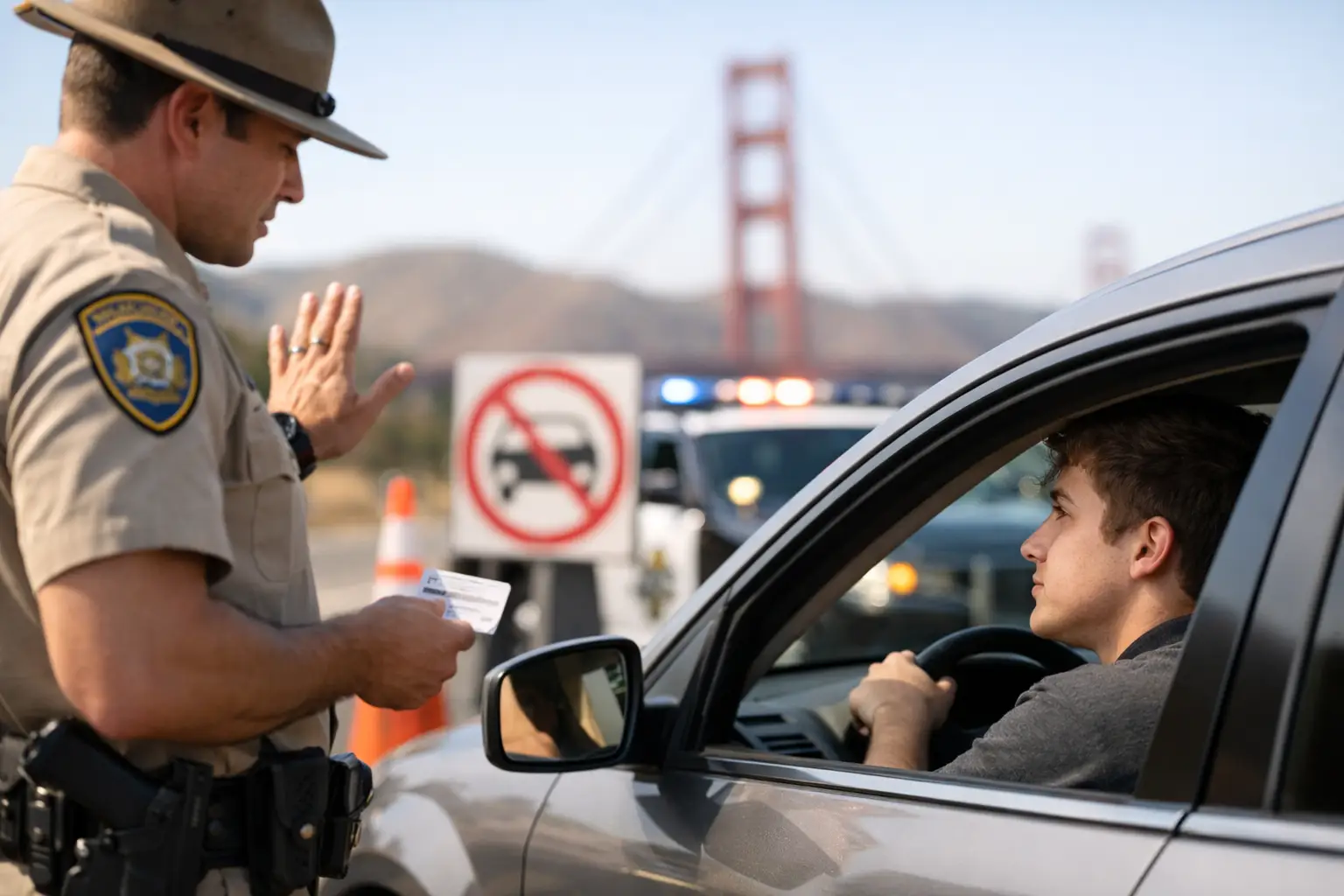
A newly licensed 16-year-old may feel ready to drive friends to the beach, pick up a late shift, or head home after a school event. California provisional license restrictions set clear limits around those situations for a reason: the first year of independent driving is when new drivers need time to build judgment without added distractions.
For teens and parents, the rules are easier to follow when they are treated as part of the learning process, not just a list of DMV requirements. Good habits around passengers, nighttime driving, phone use, and trip planning help a young driver gain confidence while protecting everyone in the vehicle.
Who receives a California provisional license?
California issues a provisional driver’s license to drivers who are under 18 when they pass their DMV drive test. Before reaching that step, a teen generally needs to hold an instruction permit for at least six months, complete driver education and professional behind-the-wheel training, and log supervised practice with a qualified adult.
That practice requirement includes at least 50 hours behind the wheel, including 10 hours at night. The total matters, but the quality of practice matters just as much. A teen who has practiced busy intersections, lane changes, parking, freeway entrances, residential streets, and nighttime visibility is better prepared to make sound decisions alone.
Once the DMV issues the provisional license, the teen may drive independently. However, the first 12 months come with restrictions that apply until the driver turns 18, whichever happens first.
California provisional license restrictions for the first year
The two rules families need to remember are the passenger restriction and the nighttime restriction.
No young passengers without a qualified adult
For the first 12 months, a provisional driver may not transport passengers who are under 20 years old unless a qualified adult is in the vehicle. The qualified adult may be the driver’s parent or legal guardian, a California-licensed driver who is at least 25, or the driver’s spouse who is at least 18 and holds a valid California license.
This rule can be difficult socially. A teen may be fully capable of driving to school or practice alone, yet still cannot give a friend a ride home. That is intentional. Passengers can create pressure to hurry, take risks, change music or navigation, and split attention at the exact stage when a new driver is still developing consistent scanning and decision-making habits.
Parents can make the rule easier to follow by discussing transportation plans before the license is issued. Decide which rides are allowed, how the teen will handle requests from friends, and who to call if a plan changes. A simple response such as, “I can’t drive passengers yet because of my license,” removes the need for a teen to argue or make excuses.
No driving between 11 p.m. and 5 a.m.
During the same 12-month period, provisional drivers may not drive between 11 p.m. and 5 a.m. unless a qualified adult is in the vehicle or a valid exception applies.
Night driving demands more than turning on headlights. Visibility is reduced, speed and distance are harder to judge, and tiredness can slow reaction time. In the South Bay, nighttime driving can also mean navigating glare, busy corridors, pedestrians near restaurants and events, or changing conditions near the coast. New drivers benefit from supervised night practice before they have to handle those situations independently.
The rule applies even when a teen has a good reason to be out late. A ride home from a friend’s house, a late movie, or an informal gathering does not automatically qualify as an exception. Families should arrange transportation in advance rather than relying on a last-minute decision.
When exceptions may apply
California recognizes that some trips cannot wait. A provisional driver may be able to drive during restricted hours or transport young passengers when there is a medical necessity, a school or school-authorized activity, an employment need, or an immediate need involving a family member.
These exceptions are specific, not a general permission slip. In several situations, the driver must carry appropriate written documentation, such as a signed statement from a parent or guardian. A medical exception may require documentation from a medical professional. School and work-related needs should be documented by the appropriate school official or employer when required.
The practical rule is to keep the explanation clear and the paperwork available in the vehicle. Before relying on an exception, parents should review the current California DMV guidance because documentation expectations can change. If there is another reasonable transportation option, that is often the safer choice.
Rules that still apply to every teen driver
A provisional license is a real driver’s license, but it does not excuse a new driver from any other California traffic law. Speed limits, complete stops, safe following distance, yield rules, seat belt requirements, and insurance requirements all apply.
For drivers under 18, cell phone use is also tightly restricted. A teen should not use a phone while driving, whether it is handheld or hands-free, except in an emergency. Even a short glance at a message can erase the time needed to notice a braking vehicle, a cyclist, or a pedestrian in a crosswalk.
Traffic tickets, collisions, and failures to appear in court can create serious licensing consequences. Beyond possible DMV action, a violation can raise insurance costs and make a parent less comfortable allowing independent driving. The best approach is not to focus on avoiding a ticket. It is to make safe choices when nobody is watching.
How parents can help a new driver follow the rules
A provisional license is a transition period for the entire household. Parents are still setting expectations, even though they are no longer sitting in the passenger seat for every trip.
Start with a family driving agreement. It does not need to be formal or complicated. Put in writing when the teen may drive, which destinations are acceptable, where the keys are kept, what to do if weather or traffic feels overwhelming, and the non-negotiable rule to call for a ride when needed. Make it clear that asking for help will never result in punishment for making the safe choice.
Continue practicing after the road test. Passing the DMV test shows that a driver meets the licensing standard on that day. It does not mean they have experienced every real-world situation. A few additional supervised drives can focus on freeway merges, parallel parking, heavy traffic, rain, dark roads, and routes the teen will use regularly.
It also helps to begin with low-pressure trips. Driving alone to a nearby job, practice, or family errand in daylight is very different from managing multiple friends after dark. Privileges can grow with demonstrated judgment, not simply with time since the license was issued.
Build skills that make the restrictions easier to outgrow
The provisional period ends after 12 months or when the driver turns 18, but the habits built during that year stay with them. A teen who checks mirrors before every lane change, leaves room around other vehicles, puts the phone away before shifting into drive, and speaks up when a passenger is distracting is building a lifelong safety foundation.
Professional lessons can be especially useful after a teen has their permit or even after they have passed the test. A patient instructor can identify small habits that family members may not notice, then provide focused practice without the pressure that sometimes comes with parent-teen instruction. South Bay Driving School helps new drivers build those repeatable skills through paced behind-the-wheel training and DMV road-test preparation.
A provisional license gives a teen meaningful independence, but it is not a deadline to rush past. Give new drivers the space to gain experience gradually, follow the restrictions consistently, and choose safety over convenience every time they get behind the wheel.