
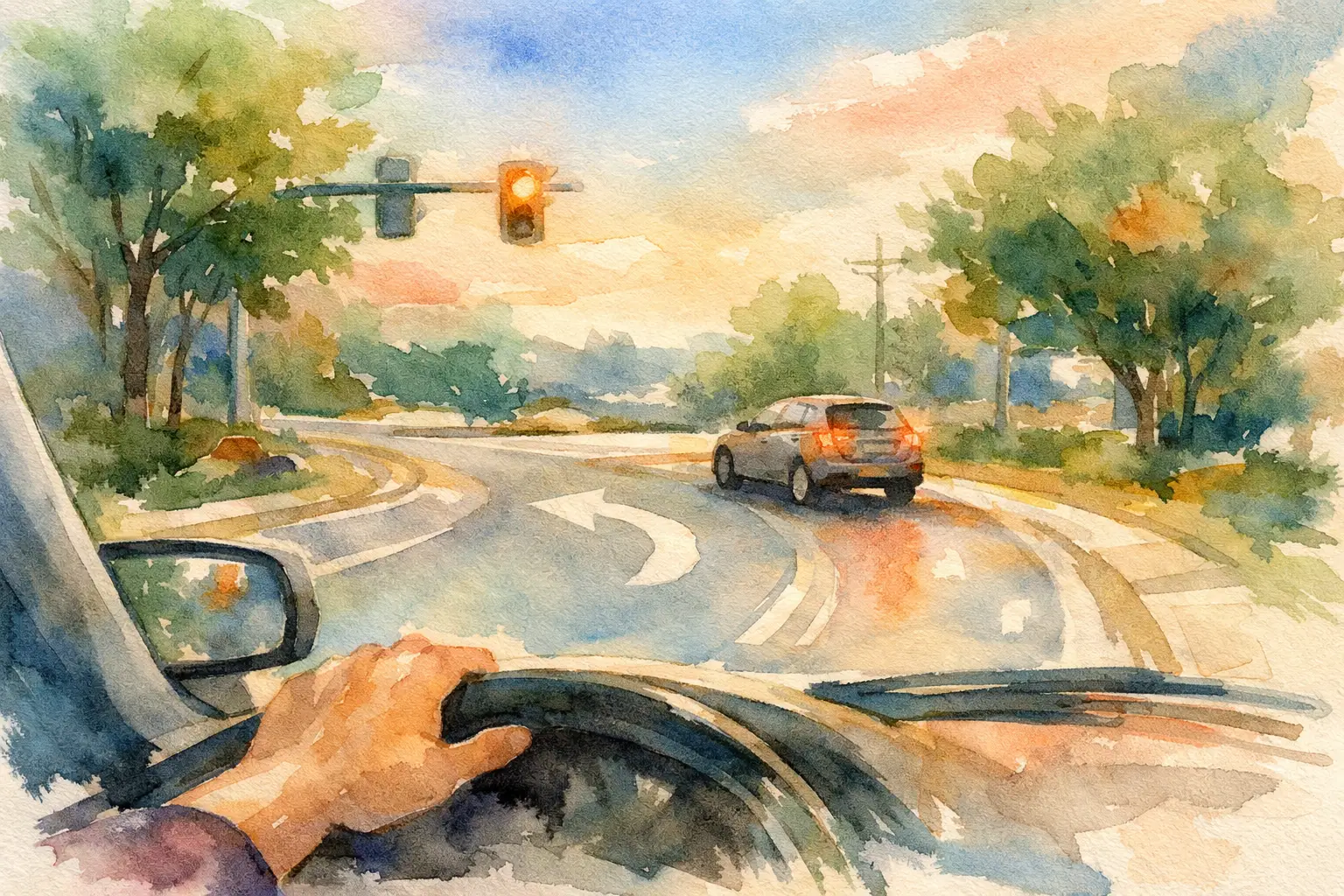
A left turn can feel like the busiest few seconds of a driving lesson. You are checking your lane position, watching for an opening, yielding to oncoming traffic, looking for pedestrians, and then steering into the correct lane. Knowing how to practice left turns in a repeatable order turns that pressure into a skill you can use on South Bay streets and at the California DMV road test.
The goal is not to rush through an opening. A safe left turn is a decision-making exercise: observe early, communicate clearly, yield when required, and complete the turn with steady vehicle control. Start in low-pressure locations and add complexity only when each part feels familiar.
Start With the Left-Turn Routine
Before practicing at a busy intersection, learn the same routine until it becomes automatic. Your instructor may use slightly different wording, but the sequence should stay consistent: check mirrors, signal, move into the correct position, scan for hazards, yield, turn, and finish in the proper lane.
In California, signal for at least the last 100 feet before turning whenever practical. Signaling early gives drivers behind you time to slow down and helps pedestrians and cyclists understand what you intend to do. Check your rearview mirror and left mirror before moving toward the center line or designated left-turn lane. A quick mirror check is not just a test habit. It tells you whether a vehicle, motorcycle, or bicycle is approaching from behind.
For a standard left turn from a two-way road, position your vehicle close to the center line without crossing it. If there is a marked left-turn lane, enter it smoothly and follow the lane markings. Avoid drifting wide or cutting across the solid lines early. Good positioning makes your next decision easier because you can see the intersection and other road users more clearly.
Practice Left Turns in Stages
Trying to learn every type of left turn at once can make a new driver freeze. Build the skill in stages, starting where traffic is light and sight lines are good. An empty parking lot helps with steering and lane placement, but it cannot teach the judgment required at a real intersection. Move to quiet neighborhood intersections as soon as you can do so safely with a licensed instructor or qualified supervising driver.
First, Practice the Steering Path
At a quiet intersection, focus on making a controlled turn without worrying about a tight traffic gap. Approach slowly, keep both hands prepared to steer, and look where you want the car to go. Your eyes should move through the intersection toward the lane you plan to enter, not down at the curb or directly in front of the hood.
Turn at an appropriate point - generally after your vehicle has reached the intersection and it is safe to begin. Steer smoothly, then allow the wheel to return naturally as the vehicle straightens. Do not let the wheel spin freely through your hands. Guide it back with control.
Finish in the lane closest to the center line on the road you are entering, unless signs, lane arrows, or road markings direct otherwise. This is a common DMV test issue. Turning too wide into the far lane can create conflict with drivers who are legally turning into that lane from the opposite direction.
Then, Add Yielding Decisions
Once the steering path feels steady, practice deciding when to wait. A green light does not automatically mean you have the right-of-way to turn left. You must yield to oncoming vehicles that are close enough to be a hazard, as well as pedestrians who are legally crossing and cyclists traveling through the intersection.
Ask yourself one practical question: if I begin turning now, will the other road user need to brake, swerve, or change speed because of me? If the answer might be yes, wait. Do not rely on another driver flashing headlights, slowing unexpectedly, or seeming far away. Speed can be difficult to judge, especially on wider roads such as those found around Torrance and Carson.
When you are waiting in an intersection for a gap, keep your wheels pointed straight ahead. If a vehicle hits you from behind, straight wheels reduce the chance that your car will be pushed into oncoming traffic. Keep scanning rather than staring at one approaching vehicle. Conditions can change quickly when a pedestrian steps off the curb or a motorcycle appears beside a larger vehicle.
Practice Protected and Unprotected Turns Separately
A protected left turn uses a green arrow. It is usually the easiest place to build confidence because oncoming traffic is stopped. Still, scan the crosswalk before moving. A late pedestrian, cyclist, or driver who runs a red light can enter your path.
An unprotected left turn happens when you have a circular green light, flashing yellow arrow, or another signal that allows a turn only after yielding. These turns require more judgment. Practice them first at intersections with slower traffic, clear views, and an instructor who can explain why one gap is safe and another is not.
The trade-off is simple: waiting may feel slow, but forcing a turn is dangerous. On a DMV road test, a cautious wait is generally far better than accepting an unsafe gap. In everyday driving, patience protects everyone involved.
Use a Safe Gap, Not a Perfect Guess
New drivers often want a single rule for how much space they need before turning left. There is no reliable one-size-fits-all number. A safe gap depends on the speed of oncoming traffic, the width of the intersection, weather, visibility, your vehicle’s acceleration, and whether pedestrians are present.
Instead of counting seconds as your only method, practice recognizing the full situation. Is the approaching car moving faster than it first appeared? Is the road wet? Are you turning uphill? Is a large truck blocking your view? Each factor means you need more space.
If you are uncertain, wait for the next opening or for the signal to change. Do not begin a turn simply because the driver behind you seems impatient. Their horn does not change your responsibility to yield.
Include Pedestrians, Cyclists, and Turning Lanes
Left-turn practice must include more than cars. Before turning, scan the crosswalk from left to right and then check it again just before you move. Pedestrians may be hard to see at dusk, behind parked vehicles, or when you are focused on oncoming traffic.
Cyclists need special attention because they can approach quickly and may be obscured by a vehicle or roadside sign. Check your mirrors before moving into a turn lane, use your signal early, and do not cut across a bike lane without checking that it is clear and making the movement legally and safely.
At multi-lane intersections, follow lane arrows and road markings closely. Some intersections have two left-turn lanes. In that case, stay in your assigned lane throughout the entire turn. Do not drift toward the other turning vehicle, even if the roadway opens up after the intersection.
Build Confidence With Purposeful Practice
A productive practice session is more useful than repeating the same easy turn for an hour. Choose one focus for each drive. One session might be about signaling and lane position. Another might be about judging oncoming traffic. A later session can include protected arrows, busy intersections, and turns made after dark.
After each turn, briefly review what happened. Did you signal early enough? Were your wheels straight while waiting? Did you enter the nearest legal lane? Did you wait for pedestrians and choose a gap that gave everyone room? This short review helps turn a nervous experience into a clear lesson.
It also helps to practice during different conditions. A quiet weekend morning is a good starting point, but eventually you should experience busier traffic, evening glare, and intersections with more pedestrians. Do this gradually. Confidence grows from successful repetitions, not from being pushed into situations that exceed your current ability.
Common Left-Turn Habits to Correct
Many left-turn errors come from looking too narrowly at one problem. Drivers may watch oncoming cars but forget the crosswalk, or concentrate on steering and fail to check mirrors before entering a turn lane. Use your full visual scan every time.
Another common habit is stopping too far back from the intersection. If it is safe and lawful to pull forward while waiting for a gap, doing so can improve visibility and allow you to complete the turn when traffic clears. Your instructor can show you the appropriate stopping position for the intersection and signal situation.
Finally, avoid accelerating too hard once you decide to go. A left turn should be deliberate, not explosive. Gentle, controlled acceleration gives you better steering control and makes it easier to respond if conditions change.
A patient instructor can help you identify the exact part of the turn that causes stress, whether it is lane placement, traffic judgment, or pedestrian scanning. With calm repetition and clear coaching, the left turn stops being a moment to fear and becomes one more safe choice you know how to make.