
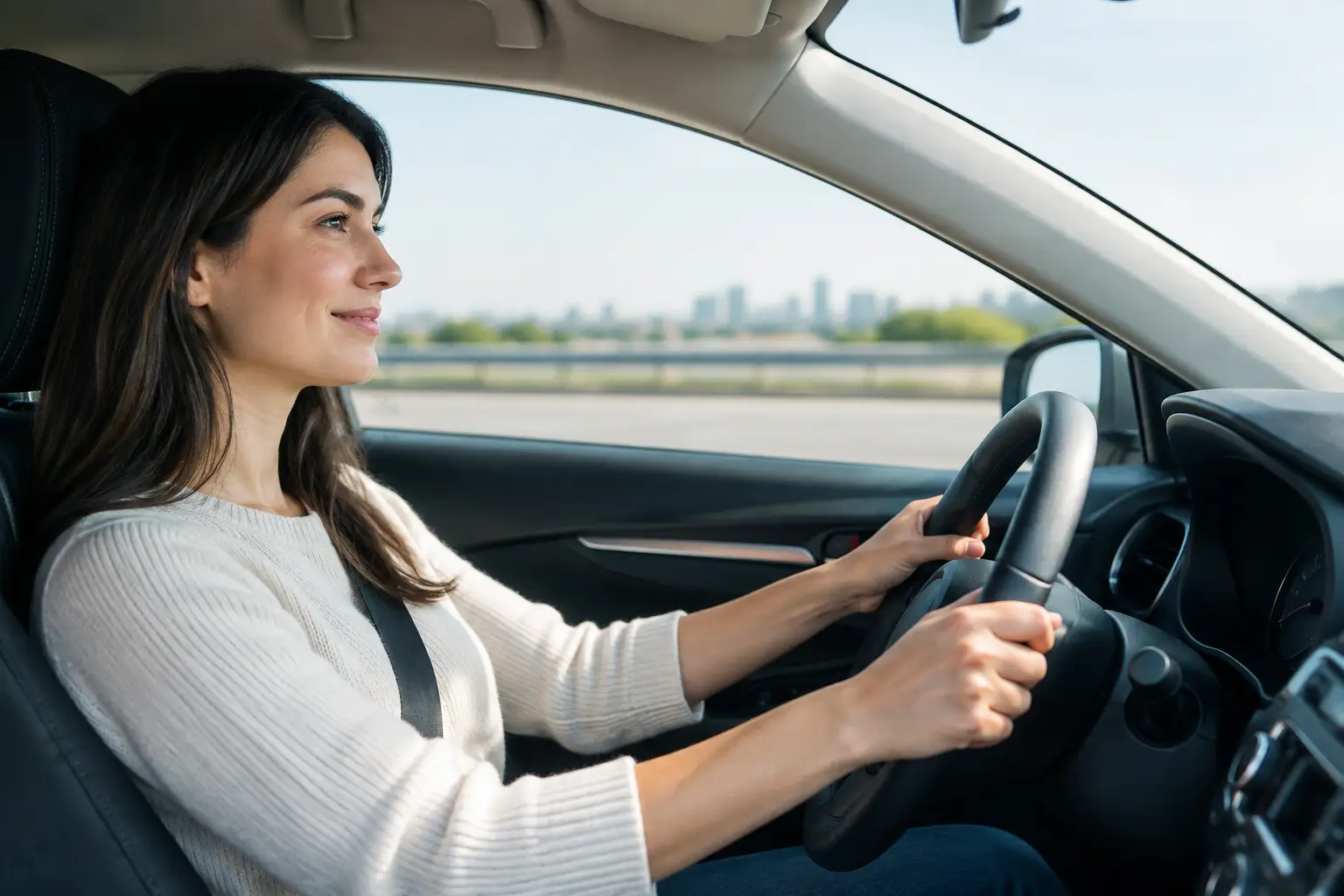
A freeway entrance ramp can make a new driver feel as if every decision has to happen at once: accelerate, check mirrors, find a gap, signal, and join traffic that is already moving quickly. That pressure is exactly why the top signs ready for freeway driving are about consistent habits, not simply feeling brave enough to try it.
For a teen driver, adult beginner, or someone returning to driving after time away, freeway readiness develops in stages. Surface-street driving builds the foundation. Freeway practice asks the driver to use that foundation at higher speeds, with less time to correct small mistakes. The goal is not to eliminate normal nerves. It is to make sure nerves do not take over the driver’s attention, judgment, or control of the vehicle.
Top Signs You’re Ready for Freeway Driving
You control the car without using all your attention
Before practicing on a freeway, basic vehicle control should feel familiar rather than mentally exhausting. You should be able to steer smoothly, maintain a stable speed, brake gradually, and make ordinary turns while still paying attention to traffic signs, pedestrians, cyclists, and other vehicles.
This does not mean every drive must be perfect. It means you are no longer so focused on keeping the car centered in the lane that you miss what is happening around you. Freeway driving requires your eyes and mind to stay ahead of the car. If basic steering or pedal control still feels unpredictable, more neighborhood and city-street practice is usually the safer next step.
You check mirrors and blind spots automatically
Freeway traffic changes quickly. Drivers enter, exit, slow down, speed up, and move between lanes with little warning. A ready driver checks the rearview mirror and side mirrors regularly, then looks over the shoulder before changing lanes. They do not rely on mirrors alone.
The key word is automatically. If you have to remind yourself every time to check a blind spot, practice lane changes on quieter multi-lane streets first. A dependable routine helps prevent rushed decisions: check mirrors, signal early, look over the shoulder, move only when there is a safe opening, and return your focus forward.
You can match speed on an entrance ramp
One of the most important freeway skills is understanding that an entrance ramp is for building speed. Drivers merging too slowly can force freeway traffic to brake or swerve. Drivers who accelerate without looking can create a different hazard.
A driver who is ready for supervised freeway practice can accelerate smoothly toward the speed of traffic while still scanning ahead, checking mirrors, and identifying an available gap. They understand that the yield sign at the end of the ramp means freeway traffic has the right-of-way. They also know there is no benefit in stopping at the end of a ramp unless traffic conditions make it necessary.
In the South Bay, some ramps are short, curved, or busy during commute hours. Starting with a less crowded route and a more forgiving entrance can help a learner practice the process without adding unnecessary stress.
You make lane changes with patience, not panic
A safe lane change is not a sudden sideways movement. It is a planned maneuver. You recognize when a lane change will be needed, check the traffic pattern early, signal, confirm the blind spot is clear, and move gradually when there is enough space.
Freeway-ready drivers also accept that a lane change is sometimes not available right away. Missing an exit is inconvenient, but forcing your way across several lanes is dangerous. Being willing to continue to the next exit shows good judgment, and good judgment matters as much as physical driving skill.
You maintain space instead of following the car ahead
At freeway speeds, following too closely leaves very little time to react. A driver should be able to choose a safe following distance, adjust when traffic slows, and avoid the common mistake of staring only at the bumper in front of them.
Look well ahead for brake lights, traffic backups, lane closures, and vehicles entering from ramps. Then use that information to ease off the accelerator early when needed. Smooth speed adjustments are safer for everyone behind you than last-second hard braking.
This skill is especially useful in heavy Los Angeles-area traffic, where a freeway can shift from open flow to stop-and-go conditions quickly. Readiness includes knowing how to stay calm when the drive is slower and more crowded than expected.
You can keep a steady lane position at higher speeds
Some new drivers do well on local streets but begin drifting within the lane as speeds increase. On a freeway, small steering corrections can feel larger, and overcorrecting can move the vehicle toward another lane or the shoulder.
A prepared driver keeps both hands positioned for controlled steering, looks far enough ahead that the car naturally tracks straight, and makes gentle corrections rather than sharp movements. They do not hug one side of the lane because they are anxious about nearby vehicles. If higher speeds make you grip the wheel tightly or zigzag between lane lines, more practice on wider roads may be helpful first.
You understand that speed limits are not targets
California freeways can have fast-moving traffic, but readiness does not mean trying to keep up with the fastest vehicle around you. A responsible driver knows the posted limit, drives for current traffic and weather conditions, and avoids becoming a hazard by driving either aggressively or unnecessarily slowly.
The right speed depends on the situation. Rain, glare, construction, heavy traffic, and limited visibility all call for more space and more caution. A driver should also be comfortable moving to a safer lane when practical instead of feeling pressured to compete with impatient drivers.
You can handle directions without losing focus
Freeway driving often involves signs, interchanges, exits, and navigation prompts arriving close together. A ready driver can listen to directions while keeping their eyes on the road. They know to plan ahead, move toward the correct lane early, and avoid looking down at a phone or navigation screen while the car is moving.
It is also a good sign when you can recover from a wrong turn calmly. Freeways offer another exit, another route, and another chance to get where you are going. Safe drivers do not make sudden turns, stop in travel lanes, or cut across traffic to fix a navigation mistake.
Readiness Depends on the First Freeway Lesson
Being ready for freeway driving does not mean starting with the busiest route at rush hour. The first practice session should be paced to the learner. A qualified instructor or experienced supervising driver can begin with a quieter stretch, explain each ramp and lane choice in advance, and provide calm coaching as conditions change.
For many learners, the best progression begins with observation. Ride along and notice how traffic merges, where vehicles tend to bunch up, and how early experienced drivers prepare for exits. Then practice short freeway segments during lighter traffic before taking on longer trips, complex interchanges, nighttime conditions, or heavy congestion.
Parents can help by keeping the first few sessions focused. Avoid combining freeway practice with a time-sensitive appointment, an unfamiliar destination, or a car full of distracting passengers. Give the new driver a clear route and enough time to make safe choices.
When More Practice Is the Smart Choice
There is no prize for getting onto the freeway before you are prepared. If merging causes you to freeze, lane changes feel rushed, or you regularly miss mirror and blind-spot checks, that is useful information. It points to specific skills to practice, not a personal failure.
Professional behind-the-wheel instruction can give learners a structured setting to strengthen those skills before freeway driving becomes necessary. At South Bay Driving School, lessons are paced around the student’s current ability, whether that means building confidence on local roads, preparing for a DMV road test, or working toward supervised freeway experience.
The freeway will still be there after a few more practice drives. When your habits are steady, your decisions are deliberate, and you can stay calm around faster traffic, that first merge becomes one more skill you know how to handle safely.