
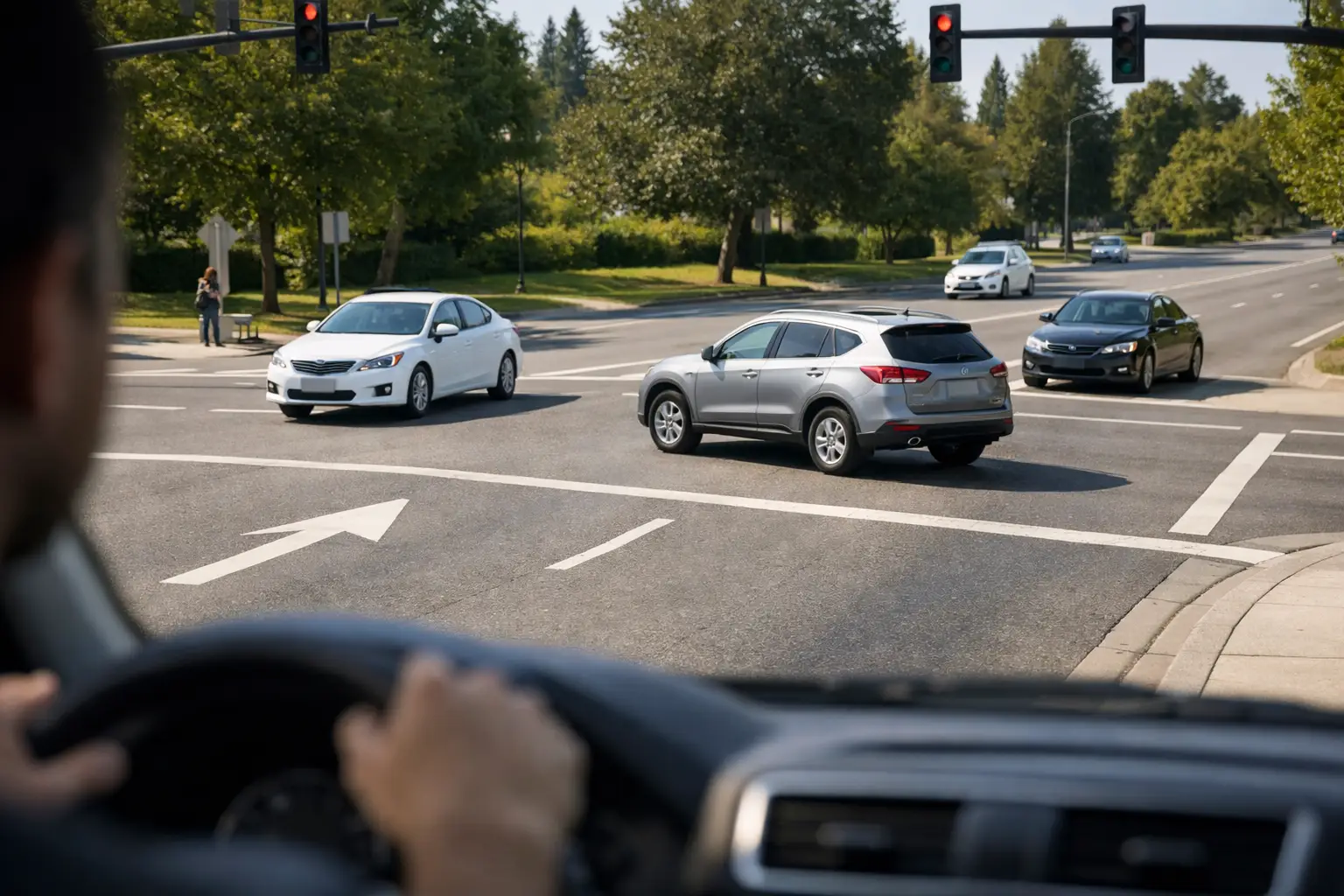
A busy intersection can make a new driver feel as if every car, pedestrian, signal, and lane is asking for attention at once. This intersection driving guide breaks that moment into a repeatable process: slow down, look early, follow the right-of-way rules, and do not move until the path is truly clear. Confidence at intersections does not come from rushing. It comes from knowing what to check and giving yourself enough time to check it.
For teen drivers, adult beginners, and drivers returning after time away, intersections deserve extra practice because they combine nearly every core skill: speed control, steering, signaling, observation, judgment, and communication with other road users. The goal is not simply to get through the intersection. The goal is to make safe, predictable decisions every time.
Why intersections demand your full attention
Many collisions happen at intersections because drivers make assumptions. A driver may assume an oncoming car will stop, a pedestrian will wait, a vehicle will turn where its signal indicates, or there is enough space to complete a left turn. Those assumptions can be costly.
Treat every intersection as an active traffic environment, even when you have a green light or the road appears empty. Scan ahead for traffic lights, stop signs, lane arrows, crosswalks, bicycles, motorcycles, pedestrians, and vehicles waiting to turn. Looking far ahead gives you time to reduce speed smoothly rather than braking hard at the last second.
In South Bay communities, drivers also encounter wide multi-lane roads, compact neighborhood intersections, school-zone crosswalks, and busy commercial areas. The exact layout changes, but the habit stays the same: approach with enough time and space to see, decide, and act safely.
The intersection driving guide: use a simple approach routine
A dependable approach routine helps reduce anxiety. As you near an intersection, ease off the accelerator when needed and look well beyond the vehicle in front of you. Identify the traffic control first: a traffic signal, stop sign, yield sign, uncontrolled crossing, or a turn lane with its own arrow.
Next, check your lane. Confirm whether you are going straight, turning right, or turning left, and move into the correct lane early. Last-second lane changes near an intersection create confusion and can put you in the path of turning vehicles, bicyclists, or pedestrians.
Then begin a deliberate visual scan. Look ahead, to the left, to the right, and toward the crosswalk. Check mirrors before slowing significantly, especially if traffic is close behind. If you plan to turn, signal well before the intersection so other drivers have time to respond.
Even with a green light, take a brief look left, right, and ahead before entering. A green light gives you the right to proceed, but it does not guarantee that another driver will obey a red light. This quick scan becomes especially valuable after the light changes from red to green.
Control your speed before the decision point
Your speed determines how much time you have to recognize hazards. Entering too quickly can make a routine turn feel rushed and can leave little room for a pedestrian stepping into a crosswalk or a vehicle entering late.
Avoid the habit of accelerating toward a yellow light. A yellow signal warns that the light is about to turn red. If you can stop safely before the limit line or crosswalk, stop. If you are already too close to stop safely, continue through carefully without speeding up. Never slam on the brakes if doing so could cause a rear-end collision, but do not treat yellow as an invitation to hurry.
At a stop sign, make a complete stop before the limit line, crosswalk, or intersection. The vehicle should be fully still, not rolling slowly. From there, look carefully in every direction before proceeding.
Right-of-way rules that new drivers should practice
Right-of-way is often misunderstood as something a driver can take. In reality, it is something you yield when the situation requires it. Being legally entitled to proceed does not remove your responsibility to avoid a collision.
At a four-way stop, the first vehicle to arrive and stop generally goes first. When two vehicles arrive at about the same time, the driver on the left should yield to the driver on the right. If another driver begins moving when it is not their turn, do not compete for the space. Let them go and reset the situation safely.
When turning left on a green light without a protected green arrow, yield to oncoming traffic close enough to be a hazard. You must also yield to pedestrians crossing the street you are turning into. Wait patiently for an opening that gives you enough space to complete the turn without forcing oncoming drivers to brake.
When turning right, look for pedestrians and bicyclists before turning, including those approaching from behind on the right. In California, a right turn on red may be allowed after a complete stop unless a sign prohibits it, but you must yield to traffic and pedestrians with the right-of-way. If you cannot see clearly around a parked vehicle, large truck, or other obstruction, wait until you can.
Crosswalks are not an afterthought
Drivers often focus so intensely on cars that they miss people in or near a crosswalk. Before every turn, look toward the crosswalk again. Pedestrians may be walking quickly, moving slowly, pushing a stroller, using a mobility device, or crossing with a child who is harder to see.
Do not stop your vehicle in a crosswalk while waiting for traffic. If traffic ahead is backed up, stay behind the limit line until you can clear the intersection. Blocking a crosswalk forces pedestrians into traffic and can create a dangerous chain reaction.
Turning without cutting corners or drifting wide
A safe turn starts with lane position and ends in the correct lane. For a right turn, approach from the rightmost lane that is marked or intended for right turns. Reduce speed before entering, check mirrors and blind spots as appropriate, yield as needed, and turn into the nearest available lane unless signs, markings, or conditions direct otherwise.
For a left turn, approach from the lane nearest the center line or the designated left-turn lane. Keep your wheels pointed straight while waiting for a gap. If you turn the wheel left while stopped and another vehicle hits you from behind, your vehicle could be pushed into oncoming traffic.
During the turn, look where you want the vehicle to go, not at the curb, median, or cars beside you. Do not cut sharply across the corner, and do not drift into a neighboring lane. If you realize you are in the wrong lane, continue safely and correct your route later. A missed turn is inconvenient. An unsafe correction can cause a crash.
How to handle the intersections that feel confusing
Uncontrolled intersections have no stop signs or traffic signals. Slow down, scan carefully, and be prepared to yield. On narrow residential streets, parked vehicles, landscaping, and building corners can hide approaching traffic. Reduce speed enough to see before entering.
At a flashing red signal, treat the intersection like a stop sign. At a flashing yellow signal, proceed with caution and be ready to yield. At a protected turn arrow, follow the arrow and remain alert for pedestrians, cyclists, or a driver who enters unexpectedly.
Multi-lane intersections require extra patience. Before changing lanes near one, check mirrors and blind spots and avoid forcing your way into a turn lane. Watch for vehicles turning across your path, especially large trucks that may need more room to complete a turn. Motorcycles can be difficult to judge because they appear smaller and may approach faster than expected.
If another driver honks or pressures you, do not let that rush your decision. Pause, breathe, check again, and proceed only when it is safe. A calm driver makes better choices than a hurried one.
Build intersection skills through focused practice
Practice works best when it is structured. Begin at quiet intersections during low-traffic periods, then progress to busier roads, protected and unprotected left turns, multiple turn lanes, and intersections with pedestrians and cyclists. Repeating the same observation routine helps the steps become natural.
A patient instructor can also identify habits that are difficult to notice on your own, such as stopping too far past the line, looking only one direction, braking too late, or turning too wide. South Bay Driving School uses behind-the-wheel practice to help drivers build these skills at a pace that supports real confidence, not just test-day memorization.
The next time you approach an intersection, give yourself permission to slow down and make the safe choice. A few extra seconds of observation can protect you, your passengers, and everyone sharing the road.