
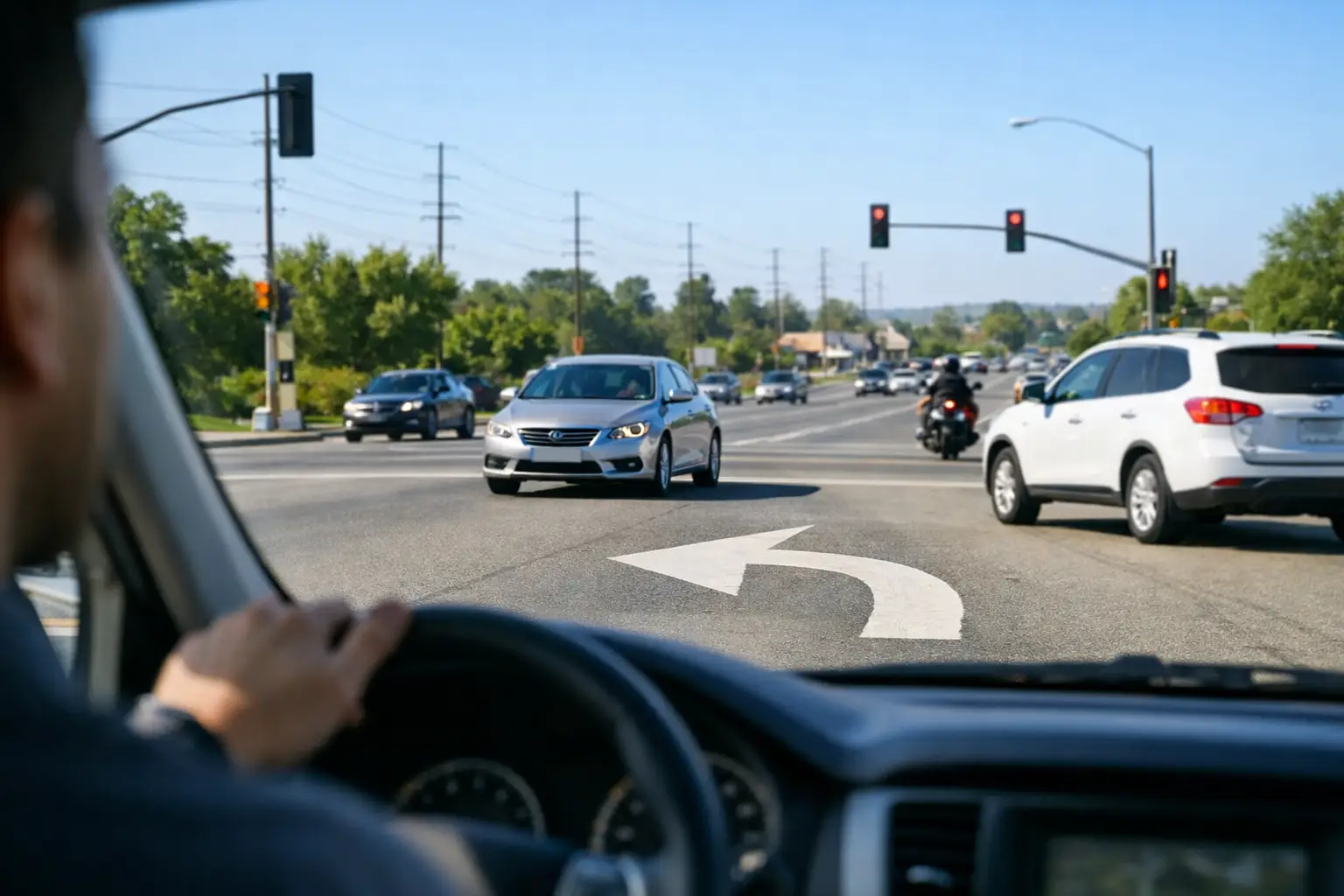
A green light does not always mean you can turn. At many South Bay intersections, a driver turning left on a solid green must wait for a safe opening in oncoming traffic. That moment can feel stressful for new drivers, especially when cars are behind them and the signal is about to change. Learning how to navigate unprotected turns means replacing guesswork with a calm, repeatable decision process.
An unprotected turn is not about being fast or overly cautious. It is about reading the intersection, yielding correctly, and committing only when the path is truly clear. Those habits help on the DMV drive test, but more importantly, they protect you, your passengers, pedestrians, cyclists, and other drivers.
What Makes a Turn Unprotected?
A protected turn is controlled by a dedicated green arrow. Oncoming traffic is stopped or otherwise prevented from crossing your path, so you may proceed while still checking for pedestrians and other hazards.
An unprotected turn happens when you have a circular green light, a flashing yellow arrow, or another signal that allows a turn only after you yield. The most common example is a left turn across oncoming lanes at a solid green light. You may enter the intersection when appropriate, but you do not have the right-of-way over oncoming vehicles traveling straight.
Right turns can also require the same careful judgment. A right turn on red, where legal and not prohibited by a sign, requires a complete stop and a full check for cross traffic, pedestrians, and bikes before proceeding. A right turn at a green light may still be unprotected if someone is crossing in the crosswalk or a cyclist is continuing through the intersection.
Set Up Before You Reach the Intersection
Safe turns begin well before the corner. Check your mirrors, activate your turn signal early enough to communicate your plan, and move into the correct lane without rushing. For a left turn, position your vehicle near the center line or in the designated left-turn lane. For a right turn, move close enough to the curb or right edge of your lane to discourage a vehicle or bicycle from trying to pass on your right, while maintaining a safe position.
As you approach, reduce speed gradually. This gives you more time to read the signal, see lane markings, and notice people waiting near the crosswalk. It also keeps you from arriving at the intersection too quickly and feeling pressured to make a poor gap decision.
Look beyond the first car in front of you. Notice whether oncoming traffic is moving freely, whether a large truck is blocking your view, and whether the signal may soon change. At busy Torrance-area intersections, traffic can appear to leave a gap and then close it quickly. A gap is only useful if you can clearly see it and have enough time to complete the turn without forcing another driver to brake.
How to Navigate Unprotected Left Turns Step by Step
When the light is green and there is no green arrow, yield to oncoming traffic and anyone legally in the crosswalk. If it is safe to do so, pull forward into the intersection with your wheels pointed straight ahead. Keeping the wheels straight matters: if a vehicle hits you from behind, straight wheels reduce the chance that your car will be pushed into oncoming traffic.
Stop in a position that allows you to see oncoming vehicles without blocking the crosswalk. Continue scanning. Look at the speed and distance of approaching cars, not simply whether they seem far away. A car traveling quickly can cover more distance than a new driver expects.
When you identify a safe gap, check the crosswalk again, look through the turn, and make the turn smoothly. Accelerate enough to clear the intersection promptly, but do not cut the corner or drift into the wrong lane. In California, a left turn should generally finish in the lane closest to the center line of the road you are entering, unless signs or markings direct otherwise.
If there is no safe gap, wait. Drivers behind you may be impatient, but they do not get to decide whether your turn is safe. Never turn because another driver honks. A horn is not a traffic signal and does not create a safe opening.
If you are already waiting in the intersection when the signal turns yellow, yield to any oncoming vehicles that are still legally entering or traveling through the intersection. Once the path is clear, complete your turn carefully. Do not back up. If you have not entered the intersection, remain behind the limit line and wait for the next signal cycle.
Judge Gaps by Time, Not Pressure
The hardest part of an unprotected turn is deciding whether a gap is large enough. There is no single number that works at every intersection because speed, visibility, road conditions, vehicle size, and the width of the roadway all matter.
A practical rule is this: if you have to accelerate aggressively, guess what an approaching driver will do, or hope the gap holds, it is not a comfortable gap. Wait for a better one. Rain, glare, darkness, or a blocked view should make you more conservative. So should turning from a stop in a larger vehicle or making a turn across multiple lanes.
Be especially careful with motorcycles. Their smaller size can make them appear farther away or slower than they really are. The same applies to cyclists traveling straight through a bike lane or along the right side of traffic. Before turning, take an extra moment to make sure a motorcycle, bicycle, or pedestrian is not hidden in a blind spot or behind a larger vehicle.
Avoid These Common Unprotected-Turn Mistakes
New drivers often focus so intensely on oncoming cars that they forget the crosswalk. Before every turn, make a final left-right-left scan for pedestrians, cyclists, and vehicles. A pedestrian may enter late in the signal cycle, and a cyclist may be traveling faster than expected.
Another common mistake is creeping too far forward before visibility is clear. Moving slowly is not automatically safer if your vehicle enters the crosswalk, blocks another lane, or leaves you with no room to react. Ease forward only as much as necessary to improve your view while respecting the limit line and crosswalk.
Avoid turning your steering wheel left while waiting. Avoid following the car ahead into the intersection without independently checking the gap. And do not assume an oncoming driver will turn simply because their signal is on. Signals can be forgotten, canceled, or misleading. Yield until the vehicle actually begins the turn and its path is clearly out of yours.
What DMV Examiners Look For
During a California DMV drive test, an examiner is not looking for a driver who takes every possible opening. They are looking for controlled observation, sound judgment, correct yielding, and a turn that stays in the proper lane.
Make your observations visible through natural head and eye movement. Signal at the proper time, approach at an appropriate speed, stop where required, and check the intersection before moving. If the gap is questionable, waiting is usually the better decision. A safe driver knows that patience is an active skill, not hesitation.
Practice also matters because each intersection feels different. A quiet residential turn may offer clear sight lines, while a major street near Redondo Beach, Gardena, or Torrance may involve multiple lanes, pedestrians, delivery vehicles, and heavier traffic. Behind-the-wheel instruction can help drivers practice these situations with patient coaching until the sequence becomes familiar.
Build Confidence Through Repetition
Start practicing unprotected turns in lower-traffic areas and at times when you can focus without heavy pressure. As your judgment improves, move to wider streets, busier signals, and more complex intersections. Talk through the process at first: signal, position, slow down, scan, yield, choose a safe gap, check the crosswalk again, and complete the turn in the correct lane.
Confidence comes from making good decisions repeatedly, including the decision to wait. Every safe unprotected turn is proof that you can stay calm, read the road, and give yourself the time you need.