
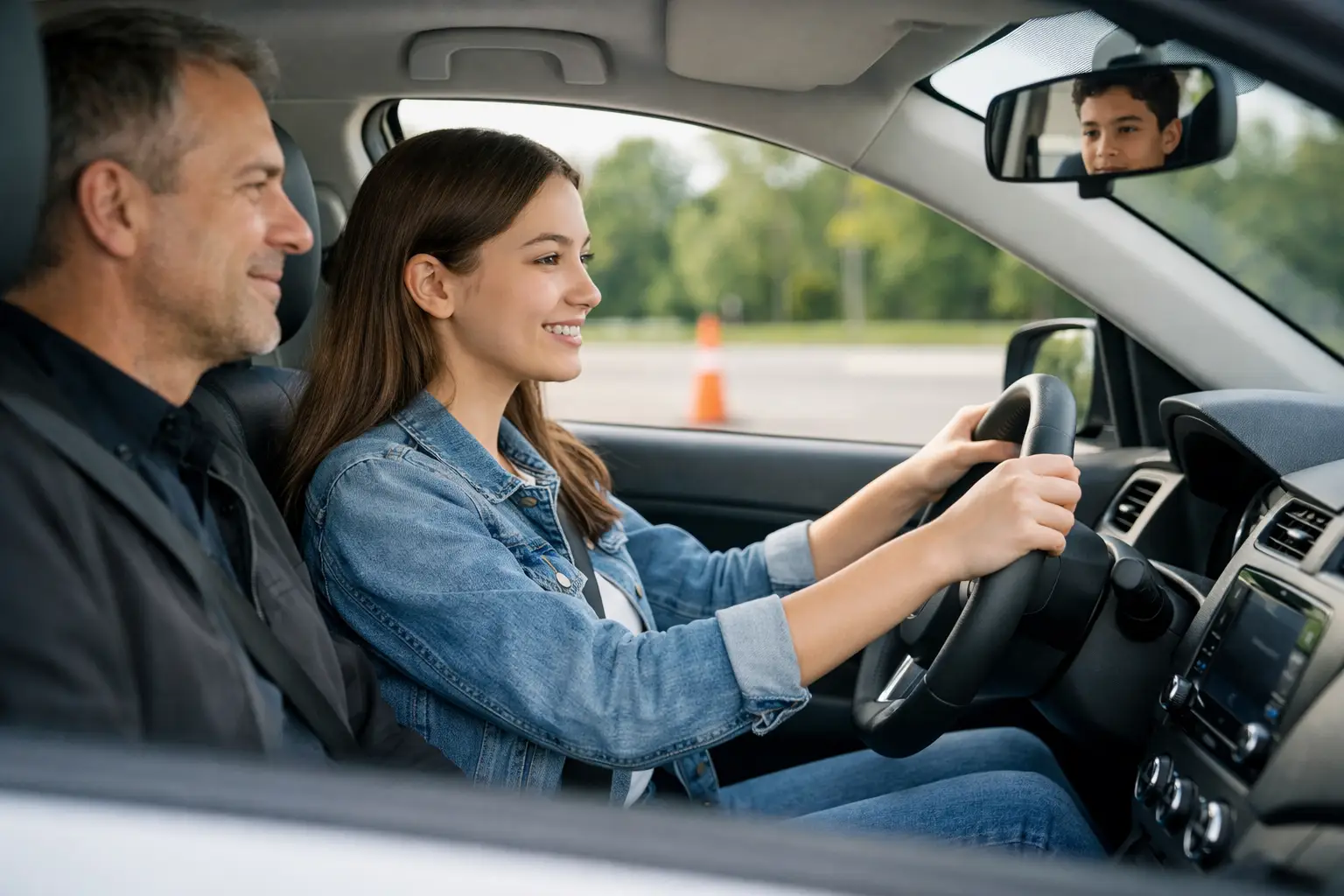
A learner's permit can make driving feel suddenly urgent. Teens want the freedom to get to school, work, practice, and friends' houses on their own. Parents see something different: busy intersections, freeway entrances, distracted drivers, and the responsibility of sharing the road safely.
A good teen driving school brings those two perspectives together. It gives new drivers a calm, structured place to build skills while giving families a clearer path from permit to California road test. The goal is not simply to help a student pass once. It is to help them make sound decisions when no instructor is sitting beside them.
What a Teen Driving School Should Actually Teach
Driving is more than knowing where the pedals, mirrors, and turn signals are. A teen may learn the basic controls quickly, then need time to use them consistently while watching traffic, judging space, and responding to changing conditions. That is where professional behind-the-wheel instruction makes a real difference.
Early lessons should focus on vehicle control and observation. Students need to learn smooth braking, controlled acceleration, steering through turns, proper lane position, mirror checks, and safe scanning habits. These basics can sound simple, but they become much harder when a driver is also processing traffic lights, pedestrians, parked cars, bikes, and other vehicles.
As confidence grows, instruction should move into real driving situations. That can include residential streets, multi-lane roads, busy intersections, left turns, lane changes, parking, freeway preparation, and defensive driving habits. In the South Bay, a new driver may encounter everything from narrow neighborhood streets to fast-moving boulevards and crowded shopping areas. Practice should prepare them for the roads they will actually use.
Just as important, lessons should explain the reason behind each action. A student who understands why they should leave following space, check a blind spot, or slow before a turn is more likely to repeat that habit independently. Memorizing a maneuver may be enough for a test. Understanding the risk helps create a safer driver.
Confidence Should Be Earned, Not Rushed
Nervousness is normal for first-time drivers. Some teens grip the wheel too tightly, brake too early, or become overwhelmed when several things happen at once. Others are comfortable at first but may overestimate their ability before they have enough experience in varied traffic conditions.
Neither response calls for pressure. A patient instructor can adjust the pace of a lesson, repeat a skill without judgment, and give feedback while the experience is still fresh. Progress is rarely perfectly linear. A student may park well one day and struggle with it the next, especially when the environment changes.
The right pace depends on the teen. A student who has never driven may need extra time on quiet streets before handling busy traffic. A teen with plenty of supervised practice may be ready to focus on lane changes, freeway merging, or DMV test preparation. Personalized instruction respects those differences while keeping safety standards consistent.
A Clear Path From Permit to California License
For families, the licensing process can feel like a series of deadlines and separate tasks. Driver education, permit testing, professional training, parent-supervised practice, and the DMV road test all matter. A driving school should help make the sequence easier to understand without treating it as a shortcut.
Online driver education can give teens flexibility to complete required learning around school, sports, and work schedules. It should cover traffic laws, signs, right-of-way rules, alcohol and drug awareness, distracted driving, and defensive decision-making. The strongest programs encourage students to understand the material, not just race through it for a completion certificate.
Behind-the-wheel lessons then turn that knowledge into action. A teen may know that they must yield to pedestrians, for example, but still need practice recognizing a crosswalk early enough to slow smoothly and stop with room to spare. They may understand blind spots in theory but need repeated reminders to check over their shoulder before changing lanes.
Professional lessons do not replace the practice a teen needs with a parent or guardian. They serve different purposes. Instructors teach a consistent system and identify weak spots that may be easy to miss during casual practice. Family driving time gives the teen repetition in familiar routes, different weather, nighttime conditions, and everyday errands.
Parents should also keep current California DMV requirements in view, since licensing rules and documentation can change. Rather than scheduling the road test based only on a calendar date, look at readiness. Does the teen drive predictably? Can they recover calmly from a mistake? Do they scan ahead, communicate with signals, and make safe choices without being reminded? Those answers matter more than whether they have practiced one particular parking maneuver a few times.
How to Choose a Teen Driving School
A driving school is not just a service that checks off required hours. The instructor, lesson structure, and vehicle environment can shape how a young driver feels about being behind the wheel. Parents should look for a school that treats safety and communication as central to the program.
Four practical questions can help narrow the choice:
- Is the school properly licensed and experienced in teaching California teen drivers?
- Are lessons private and paced to the student's current skill level?
- Does the instructor give clear, respectful feedback that a teen can use on the next drive?
- Are scheduling, pickup and drop-off options, and package details explained clearly before booking?
Experience matters because teaching is not the same as simply being a skilled driver. A capable instructor knows when to let a student work through a decision and when to intervene. They can break a complicated task into manageable steps, such as teaching a lane change through mirror checks, signaling, blind-spot checks, speed adjustment, and a smooth move into the lane.
Convenience also matters, especially for busy families. In areas such as Torrance, Redondo Beach, Manhattan Beach, Gardena, Carson, and San Pedro, pickup and drop-off service can make lessons easier to fit around school and family commitments. That convenience should support quality instruction, not replace it. A teen still needs enough time in each lesson to settle in, practice deliberately, and discuss what to improve.
Price is naturally part of the decision, but the lowest rate is not always the best value. Consider what is included, how lessons are structured, whether there are package options, and whether the school can provide appropriate road-test preparation when the student is ready. Clear communication is a good sign that a school will be dependable throughout the process.
How Parents Can Support Better Practice
Parents and guardians play a major role after the professional lesson ends. The most helpful approach is calm, specific coaching. Instead of saying, “Be careful,” point out an action the teen can take: “Start slowing earlier for this light,” or “Check the crosswalk before turning right.” Specific feedback gives them something they can repeat.
Try to build practice gradually. Begin with routes the teen knows, then add new challenges one at a time. A trip to a quiet parking lot may lead to residential driving, then busier intersections, then routes with lane changes. Night driving, rain, and freeway driving should be introduced when the teen has a solid foundation and the conditions are appropriate.
It also helps to avoid turning every drive into a running critique. New drivers need enough direction to stay safe, but too many comments can make them freeze or tune out. When possible, discuss a few observations after parking. Ask what felt comfortable, what felt difficult, and what they would do differently next time. That conversation builds judgment instead of dependence.
Road-Test Prep Is More Than a Practice Route
As the DMV road test approaches, focused preparation can reduce uncertainty. A teen should know how to adjust mirrors and seating, operate the basic vehicle controls, make safe turns, change lanes correctly, back up with control, and follow directions without rushing. They should also understand that examiners evaluate overall safety, awareness, and control, not just a perfect performance.
A road-test preparation lesson is useful when it identifies patterns that need attention. Common issues include incomplete stops, late signaling, wide turns, weak observation at intersections, inconsistent speed, and hesitation that disrupts traffic. These are correctable when a student has time to practice them before test day.
No one can promise a passing result, because test conditions and individual performance vary. What a well-prepared student can bring to the test is a reliable routine: look ahead, check mirrors, communicate intentions, leave space, follow the law, and stay composed after a small mistake. Those are the same habits that protect them after they receive a license.
A license gives a teen more independence, but safe driving develops through repetition and thoughtful choices long after the DMV appointment. With patient training, meaningful family practice, and support from an established local school such as South Bay Driving School, a new driver can leave the driveway with more than test-day skills - they can carry habits that make every trip safer.