
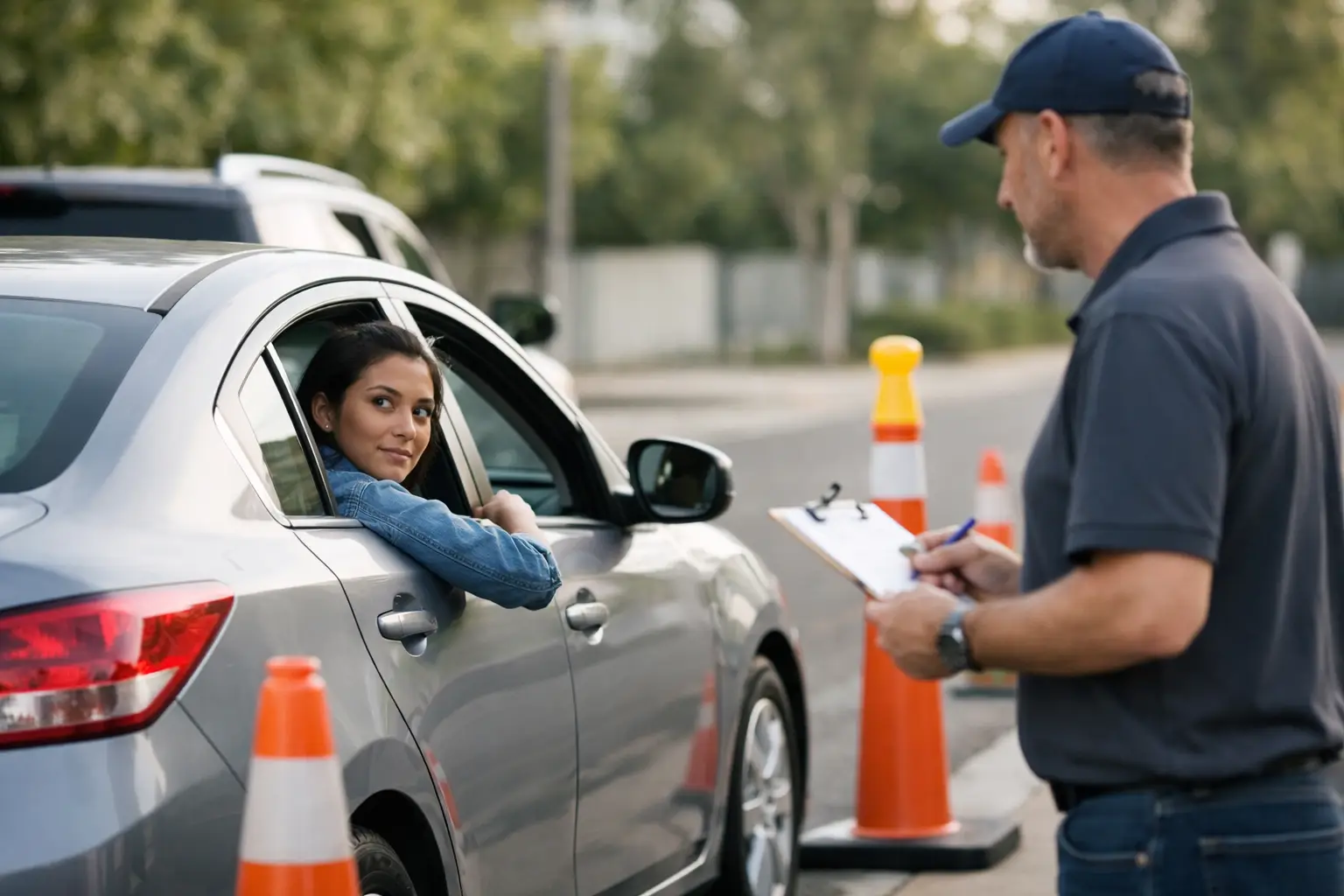
A lot of California permit holders spend their last few practice sessions worrying about one question: Will there be a parallel parking DMV test California examiners expect me to pass? The reassuring answer is that parallel parking is not a required maneuver on the standard California DMV behind-the-wheel test. That said, parking control, curb awareness, backing safely, and observation habits still matter a great deal.
For nervous teen drivers and adults returning to the road, this distinction is useful. You do not need to treat parallel parking as the one skill standing between you and a license. You do need to show the examiner that you can control the vehicle calmly, follow directions, scan for hazards, and make safe decisions in real traffic.
Is Parallel Parking on the California DMV Driving Test?
On a standard California DMV road test, the examiner does not require you to parallel park between two vehicles. California's test focuses on the skills drivers use continuously on public roads, including turns, lane changes, intersections, traffic checks, speed control, and safe vehicle operation.
You may still be asked to pull over at the curb, reenter traffic, or back in a straight line. Those tasks are not the same as parallel parking, but they reveal similar habits: checking mirrors, looking over your shoulder when backing, judging distance, signaling, and keeping the car under control.
Test routes and instructions can vary by DMV office and traffic conditions, so review the current California DMV test information before your appointment. More importantly, avoid preparing only for a narrow list of maneuvers. A driver who is safe, observant, and steady is better prepared than one who has memorized a route or practiced a single parking technique repeatedly.
What the Examiner Is Watching During Parking Tasks
When an examiner directs you to pull over, do not rush to the curb. Treat it as a complete driving task. Signal early, check your mirrors, check over your shoulder for cyclists or vehicles beside you, and move toward the curb smoothly when it is safe.
Your final position matters. Stop close enough to the curb that you are not blocking traffic, but do not scrape the tire or climb onto the curb. Keep the vehicle reasonably straight and avoid stopping abruptly. If you need a small adjustment and can make it safely, a controlled correction is usually better than forcing the car into a poor position.
When it is time to leave the curb, scan again before moving. Signal, check mirrors, look over your shoulder for traffic in the lane, and accelerate gently into a safe opening. Many drivers focus so intensely on getting parked that they forget the more important question: How will I safely return to traffic?
Backing up safely
Straight-line backing is a skill that deserves real practice before the test. The key is to move slowly and look through the rear window by turning your head and body. Mirrors can support your awareness, but they should not replace looking where the vehicle is traveling.
Keep both hands ready to steer, use very small steering corrections, and back only as far as instructed. A common mistake is looking forward at the steering wheel or relying on a backup camera. Cameras are helpful tools, but the examiner needs to see active observation and control.
Curb approach and hill parking
Depending on the route, you may need to demonstrate parking near a curb or explain how you would secure the vehicle on a hill. Know how to use the parking brake and how to position your front wheels based on whether the road slopes uphill or downhill and whether a curb is present.
This is less about reciting a rule and more about preventing a parked vehicle from rolling into traffic. Practice the process until it feels methodical: stop, secure the vehicle, position the wheels correctly, and check the area before opening the door or pulling away.
Why Parallel Parking Is Still Worth Learning
Even though it is not part of the standard DMV test, parallel parking is a practical Southern California driving skill. Street parking in Torrance, Redondo Beach, Hermosa Beach, Manhattan Beach, San Pedro, and many busy Los Angeles neighborhoods often requires it. Avoiding every tight curbside space can make everyday errands more stressful than they need to be.
Parallel parking also teaches useful vehicle-control lessons. You learn where the corners of your car are, how quickly it turns at low speeds, how to use reference points without staring at them, and when to stop and reset. Those lessons carry over to parking lots, driveways, narrow streets, and crowded school pickup areas.
The trade-off is time. If your DMV appointment is close and you are still working on basic steering, right-of-way rules, lane changes, and observation, prioritize the skills that are more likely to affect your test. Once those habits are solid, parallel parking is an excellent next step for building independence.
A Low-Stress Way to Practice Parallel Parking
Start in an empty, quiet area with cones or other soft visual markers rather than practicing immediately between parked cars. Set up a space that is comfortably longer than your vehicle. The goal at first is not perfection. It is learning to move slowly, observe continuously, and understand how the car responds as you turn.
Approach the space slowly, signal, and stop alongside the front marker with enough side clearance. Check mirrors and look over your shoulder before reversing. Back at a crawl while turning toward the curb, then straighten briefly as the rear of the vehicle enters the space. Turn away from the curb to bring the front of the vehicle in, stopping whenever you need to reassess.
There is no prize for completing the maneuver in one continuous motion. In real life, careful adjustments are normal. If you lose your angle, stop, look around, and correct it. What matters is that every movement is slow, intentional, and safe.
As you improve, make the space smaller and practice on actual residential streets when traffic is light. Choose locations where you will not hold up impatient drivers. A calm environment lets a new driver concentrate on scanning, steering, and speed rather than feeling pressured to perform.
Common Parking Habits That Create Trouble on Test Day
The biggest issue is often not parking skill but observation. Drivers may signal and turn toward the curb without checking for a bike rider, pedestrian, or vehicle approaching from behind. Build the habit of checking mirrors and blind spots every time you move laterally, pull from a curb, or reverse.
Another problem is steering while the car is moving too fast. Low-speed parking calls for patience. Light brake pressure and gentle acceleration give you time to judge space and make minor corrections. Fast steering inputs often lead to wide turns, curb contact, or unnecessary anxiety.
Finally, do not let a minor mistake take over the rest of the drive. If you park farther from the curb than you intended, stay composed. Follow the examiner's next instruction, continue scanning, and drive safely. A road test evaluates your overall ability, not whether every moment looks flawless.
Build Skills for the Test and the Road Ahead
The best DMV preparation connects each practice session to real driving. Work on smooth stops, lane position, turns, intersections, parking near curbs, backing, and defensive observation. Then add parallel parking as a practical life skill rather than a source of last-minute fear.
A patient instructor can help identify the specific habit that needs attention, whether that is judging curb distance, checking blind spots, controlling speed, or staying calm after an error. South Bay Driving School's behind-the-wheel lessons are designed to give new and returning drivers structured practice at a comfortable pace.
Before your test, take a moment to reset: adjust your seat and mirrors, know the vehicle controls, listen carefully to each direction, and give yourself time to make safe choices. Confidence does not mean never feeling nervous. It means having repeatable habits that keep you safe even when you are.